Custom Canvas Tote Bag Size Guide: How to Choose the Right Dimensions
Choosing the right size is one of the most important decisions when ordering custom canvas tote bags in bulk. A bag that is too small may not accommodate the intended products, documents, or promotional materials. A bag that is unnecessarily large can affect its appearance, storage requirements, packaging, and shipping efficiency.
For B2B buyers, selecting a suitable size involves more than choosing a width and height. You also need to consider the bag’s depth, opening, handle length, intended contents, construction, printing area, and packaging requirements.
This guide explains how to choose custom canvas tote bag sizes, define dimensions for a supplier, and verify the finished product before approving a bulk order. Explore our custom canvas tote bags to review available designs and customization options for your project.
1. What Dimensions Should You Specify for a Canvas Tote Bag?
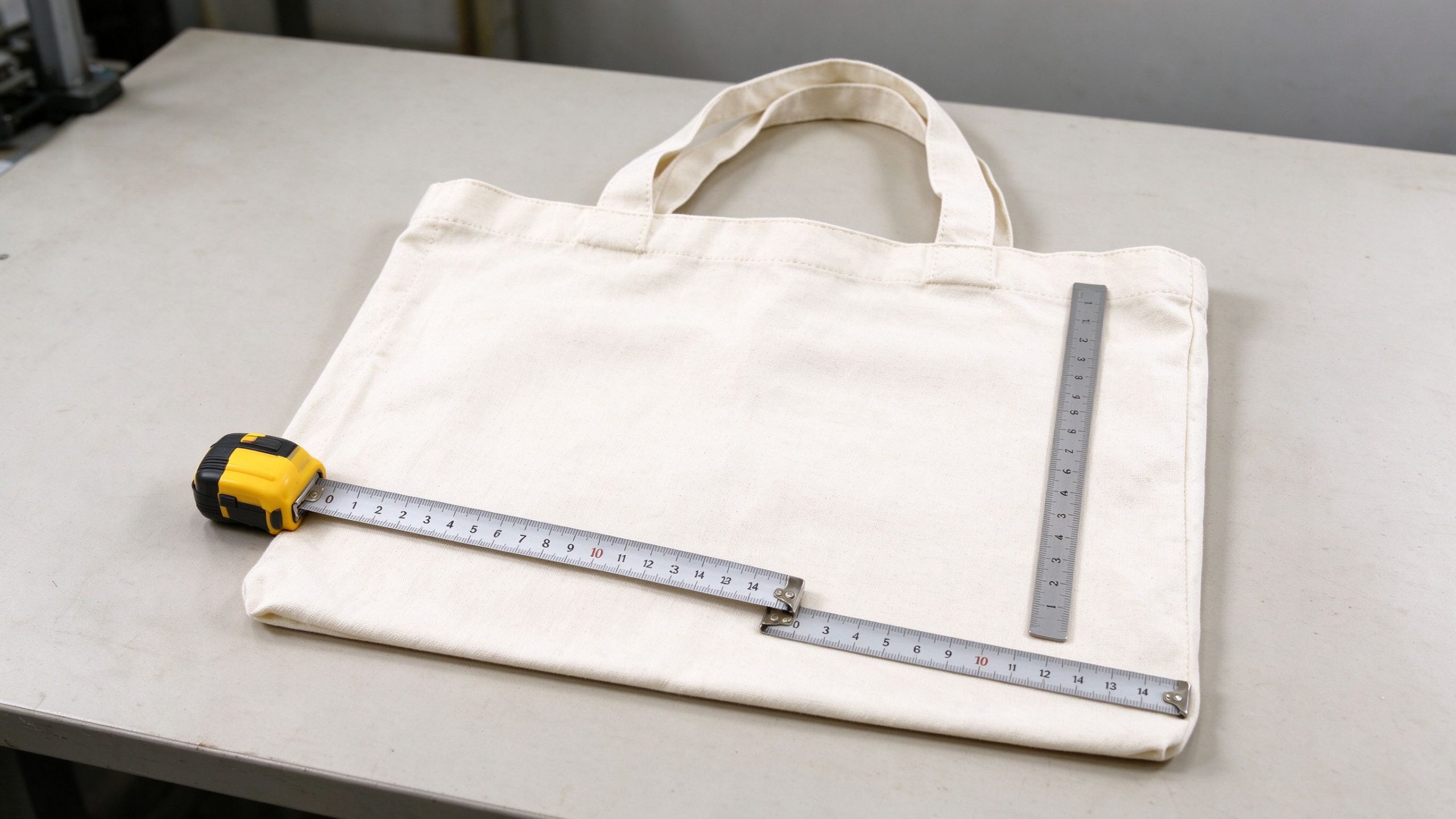
A tote bag’s size should be described using a consistent set of measurements. Otherwise, two suppliers may interpret the same request differently.
Bag width
Width usually refers to the horizontal measurement across the front of the bag. It affects how much space is available for the intended contents and how the bag’s front panel appears.
Width can also influence the available logo or artwork area. However, the printable area may be smaller than the entire front panel because of seams, folds, handles, or other design restrictions. When specifying width, clarify whether the measurement refers to the finished bag and where the measurement should be taken.
Bag height
Height describes the vertical dimension of the bag body. For procurement purposes, distinguish the body height from the total height that includes the handles.
This distinction matters when the bag must accommodate documents, product packaging, or merchandise of a particular size. Ask the supplier to specify whether the quoted height excludes handles and whether it is measured from the bottom seam to the top edge.
Gusset depth
A gusset is a section of material that allows the bag to expand in depth or width. Depending on the construction, a tote may have side gussets, a bottom gusset, or both.
Gusset depth affects the space available for contents and the bag’s shape when filled. A flat tote and a box-shaped tote can have similar front-panel dimensions while offering different usable space. If your design includes gussets, specify their dimensions separately instead of relying only on the front width and height.
Handle length and drop
Handle length and handle drop are related but different measurements. Handle length describes the full length of the handle according to the agreed measurement method. Handle drop generally refers to the distance between the top edge of the bag and the highest point of the handle when positioned for measurement.
The exact measurement method should be documented with the supplier. Handle drop is particularly important when the bag needs to be carried over the shoulder or used with bulky clothing. A handle that works for hand carrying may not provide sufficient clearance for shoulder carrying.
Opening dimensions
The opening determines how easily users can place items inside the bag and remove them. The usable opening may be affected by the bag’s shape, side seams, gussets, closures, or reinforcement.
For products that need to hold large packages, binders, or retail merchandise, confirm the opening dimensions rather than assuming they will match the maximum width of the bag body.
2. How to Choose Custom Canvas Tote Bag Sizes by Application
The most suitable size depends on what the bag needs to hold and how the end user will carry it. The following table is a planning framework, not a catalogue of standard sizes. Final dimensions should be established from the actual contents, sample requirements, and supplier capabilities.
| Application | Main sizing considerations | Details to confirm |
|---|---|---|
| Trade shows and conferences | Documents, brochures, catalogues, and promotional materials | Largest item dimensions, opening, handle drop |
| Corporate gift packaging | Gift boxes, branded merchandise, and presentation requirements | Box dimensions, gusset depth, appearance when filled |
| Retail shopping | Product dimensions, quantity, and checkout convenience | Opening width, bag depth, intended load |
| Apparel packaging | Folded clothing, accessories, or multiple items | Body width, height, gusset depth |
| Book and stationery retail | Book sizes, notebooks, and stationery sets | Largest item dimensions, opening, reinforcement needs |
| Employee welcome kits | Laptop accessories, notebooks, bottles, and branded gifts | Contents list, internal organisation, handle clearance |
| Promotional giveaways | Event materials, samples, and printed collateral | Distribution method, artwork area, packaging |
| E-commerce packaging | Product dimensions and packing workflow | Usable internal space, packing method, shipping carton layout |
Start with the largest item
Identify the largest or most restrictive item the bag must accommodate. Measure its width, height, and depth. Include its retail box or protective packaging if those will remain inside the bag. Then discuss the required clearance with your supplier.
Do not simply match the external dimensions of the item to the nominal dimensions of the bag. Seams, gussets, folds, lining, and the bag’s shape can reduce usable internal space. A sample is the best way to confirm whether the selected dimensions work in practice.
Consider how many items will be carried together
A bag designed for one notebook may not work for a complete welcome kit containing a notebook, bottle, apparel, and accessories. Prepare a list of intended contents and, where possible, provide representative samples or accurate measurements.
For irregularly shaped items, consider how they will sit inside the bag. The combined dimensions of several products do not necessarily translate directly into a suitable bag size because the items may overlap, tilt, or require additional clearance.
Consider the user’s carrying experience
The bag must be practical for its intended user. A design intended for hand carrying may use a different handle drop from one intended for shoulder carrying. The bag’s height and width should also suit the contents without making access inconvenient.
For retail merchandise, evaluate how the bag looks both empty and filled. For conference bags, check that users can insert and remove documents without forcing them through the opening.
3. How to Calculate the Space Your Tote Bag Needs
A simple planning exercise can help you communicate requirements before requesting samples.
Step 1: Measure the intended contents
Measure the widest, tallest, and deepest items that need to fit inside the bag. For packaged merchandise, measure the complete package rather than the product alone. Record whether the measurements describe rigid items, soft goods, or products that can be compressed.
Step 2: Determine the arrangement
Decide how the items should sit inside the bag. For example, documents may need to remain upright, while clothing can often be folded. Gift boxes may need to sit flat to protect their presentation. Draw a simple arrangement or take a photograph of the proposed contents.
Step 3: Allow for practical clearance
The bag’s internal dimensions need to accommodate the items without making insertion and removal unnecessarily difficult. The required clearance depends on the material, construction, opening, and intended use. Ask the supplier to recommend a prototype dimension where the contents are difficult to measure or the bag has a structured design.
Step 4: Confirm the external specification
Agree on the finished external dimensions and the measurement method with the supplier. Do not assume that the external measurements automatically represent the available internal space. If internal capacity is critical, identify the specific usable-space requirement and verify it using a physical sample.
Step 5: Test the actual contents
Place the intended products into the sample bag. Check whether they fit in the expected arrangement, whether the opening provides sufficient access, and whether the bag remains practical to carry. If the products will be distributed at an event or packed by warehouse staff, test the bag using the actual packing process.
4. How Bag Construction Affects the Size You Need
Dimensions cannot be evaluated independently of construction.
Flat bags versus gusseted bags
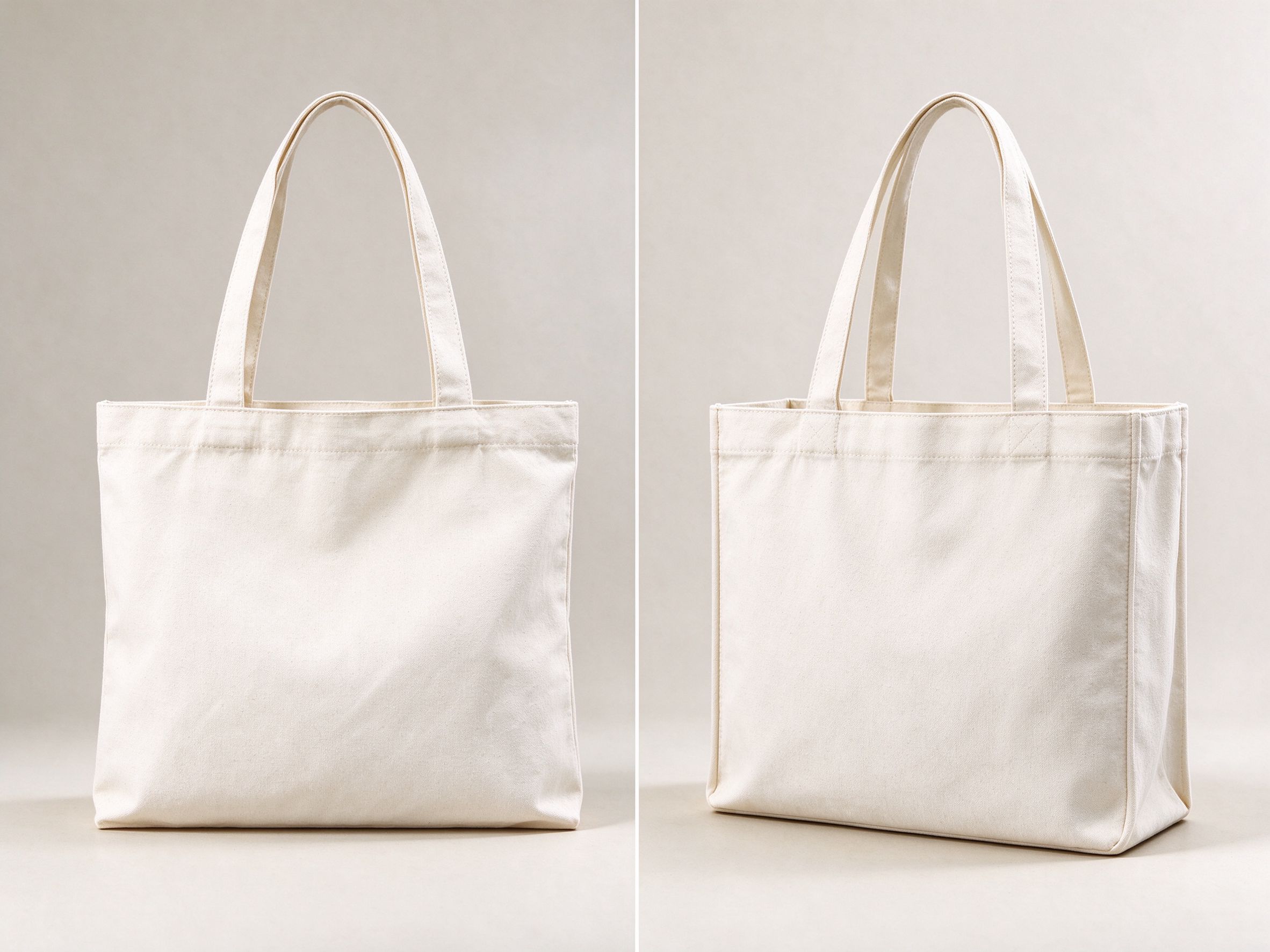
A flat tote is often suitable when the contents are relatively flat and the design does not require substantial depth. A gusseted tote provides additional space through its side or bottom construction.
However, gusset depth alone does not determine capacity. The complete shape, seams, opening, material behaviour, and dimensions must work together. For bulky products, request a sample that reflects the intended final construction rather than relying only on a flat drawing.
Reinforced bottoms
A reinforced or structured bottom can help a bag maintain its shape, depending on the design and materials used. It can also affect the finished dimensions and the way contents sit inside the bag.
If a reinforcement panel or insert is required, specify whether it is permanent or removable and how it should be included in the finished-product measurements. Do not assume that every supplier interprets “reinforced bottom” in the same way.
Lining and internal pockets
Lining and pockets may reduce the usable space available for the main contents. If your project requires internal organisation, provide the number, position, and approximate dimensions of the pockets. For bags intended to carry particular products, confirm that the pocket arrangement does not interfere with the main compartment.
Closures and top construction
Zippers, buttons, magnetic closures, and other top details can affect the usable opening. A bag may have sufficient nominal width but still be inconvenient if the opening is too narrow for its intended contents. For designs with closures, check both the opening dimensions and the usable internal space.
5. How to Choose Handle Length and Drop
Handle dimensions should be specified separately from the body dimensions.
Hand-carry designs
For hand-carry bags, focus on comfortable clearance and practical access. The intended user, the size of the bag, and the type of contents can all influence the preferred handle design. Use a sample to check whether the handles are easy to grip and whether the bag can be carried without interfering with its opening.
Shoulder-carry designs
For shoulder-carry bags, handle drop is especially important. The bag should have sufficient clearance for its intended carrying position, taking account of the user’s clothing and the bag’s expected contents. Avoid selecting handle length based only on the full handle measurement. Ask the supplier to confirm the agreed drop measurement and verify it on the sample.
Handle placement
Handle placement can affect balance and the appearance of the bag. For custom designs, specify the intended attachment points and confirm that the placement is consistent with the artwork and any reinforcement. Where the bag will carry relatively bulky items, check how the bag hangs when filled rather than assessing the handles only on an empty sample.
6. How to Define Tote Bag Dimensions for a Supplier
A clear specification sheet is more useful than a request that simply says “medium canvas tote” or “large shopping bag.” Use the following checklist when requesting a quotation.
| Specification | Information to provide |
|---|---|
| Intended application | Retail, corporate gifts, events, shopping, or another use |
| Finished body width | Required measurement and tolerance |
| Finished body height | Clarify whether handles are excluded |
| Gusset depth | Side gusset, bottom gusset, or both |
| Handle length | Full handle measurement and method |
| Handle drop | Required drop and measurement condition |
| Opening | Required usable opening, if critical |
| Internal space | Required clearance for specific contents |
| Pockets | Quantity, position, and dimensions |
| Bottom construction | Flat, gusseted, reinforced, or other specified design |
| Artwork | Logo location and required printable area |
| Sample | Approval procedure and reference sample |
| Tolerance | Agreed dimensional variation |
| Packaging | Individual packaging and carton requirements, if applicable |
If you are still comparing design options, ask the supplier to quote clearly identified alternatives rather than combining multiple unspecified features into one quotation. Any proposed change to the approved dimensions should be documented and reviewed before production.
7. How to Check Dimensions During Sample Approval
Sample approval is the point at which a drawing becomes a physical product that can be evaluated. Use the following process.
- Confirm the sample revision. Record the model, material, colour, and design revision so that measurements are associated with the correct sample.
- Agree on the measurement method. Define where width and height are measured and how the bag should be positioned. Specify whether measurements are taken with the bag laid flat, opened, or filled.
- Measure the finished body. Check width, height, and gusset depth using the agreed method. Record the results rather than relying on visual inspection alone.
- Measure the handles. Confirm full handle length and drop according to the agreed definitions.
- Test the opening and contents. Insert representative products or documents. Check that the bag accommodates them and can be used as intended.
- Review artwork placement. Confirm that the selected dimensions leave adequate space for the required logo and that seams, handles, and folds do not interfere with the design.
- Approve the reference sample. Retain the approved sample or a documented specification record. Use it as the reference for subsequent production checks.
- Agree on tolerances. Specify acceptable dimensional variation in the purchase order or approved technical document. The tolerance should reflect the product requirements and measurement method rather than an assumed universal standard.
During bulk inspection, check representative bags against the agreed specification. If dimensions differ, investigate whether the cause is measurement variation, a construction change, or a production deviation. For related guidance on verifying finished product weight and measurement conditions during approval, see our canvas tote bag weight guide.
8. Common Mistakes When Ordering Custom Canvas Tote Bag Sizes
Avoid these common procurement errors when defining custom canvas tote bag sizes.
Mistake 1: Choosing dimensions before identifying the contents. Start with the intended products and packaging. This makes the sizing decision more practical.
Mistake 2: Using vague size descriptions. Terms such as “small,” “medium,” and “large” are not enough for a production specification. Record actual dimensions.
Mistake 3: Ignoring the opening. A bag can have sufficient body dimensions but still be difficult to load if its opening is too restrictive.
Mistake 4: Confusing handle length with handle drop. These measurements are not interchangeable. Define both where necessary.
Mistake 5: Ignoring gusset construction. A flat bag and a gusseted bag may provide different usable space despite similar front-panel dimensions.
Mistake 6: Approving dimensions without a physical test. A drawing is useful, but a sample confirms how the actual construction accommodates the intended contents.
Mistake 7: Changing the design after approval. Changes to the body, gusset, handles, pockets, or closures can affect usability. Document and approve relevant changes before production.
Frequently Asked Questions
What dimensions should I provide when ordering custom canvas tote bags?
At minimum, specify the finished body width and height. If the bag has gussets, include their depth. Also provide handle length and drop where relevant, along with any critical opening or internal-space requirements.
How do I choose between a flat tote and a gusseted tote?
Consider the shape and volume of the intended contents. Flat designs may suit documents or other relatively flat products, while gusseted designs may accommodate bulkier items. Confirm the actual usable space with a sample.
Does a larger tote bag always hold more products?
Not necessarily. Capacity depends on the complete design, including gussets, opening, internal construction, and the shape of the intended contents. Evaluate the bag using the products it is designed to carry.
Should handle dimensions be included in the bag size?
Yes, but they should be documented separately from the body dimensions. Specify body height, full handle length, and handle drop where applicable.
How do I avoid size differences in bulk production?
Approve a reference sample, document the measurement method, establish dimensional tolerances, and include the agreed specifications in the purchase order. Inspect representative production samples against those requirements.
Can the supplier recommend the right size?
A supplier can help assess the proposed design if you provide the intended contents, dimensions, use case, and carrying requirements. For difficult shapes or tightly fitted products, provide a physical reference item or request a prototype.
Request a Custom Canvas Tote Bag Quotation
Planning a wholesale order of custom canvas tote bags? Provide your intended use, required dimensions, handle preferences, gusset design, logo artwork, and packaging requirements.
If the bag must accommodate specific products, include their measurements or reference photographs. This helps clarify the usable space required and reduces the risk of approving a design that does not fit the intended contents.
Browse our custom tote bags for more product and OEM options. Contact BriefcaseCustom to discuss your project and request a quotation. Final dimensions, available construction options, and production specifications should be confirmed with the supplier before sample approval.