Custom Canvas Tote Bag Sample Process: A Buyer’s Guide
A buyer approves a digital design, the factory starts sewing, and the first bulk cartons arrive with handles placed 3 cm lower than the drawing, a print that has shifted off centre, and a side gusset that refuses to lie flat. The entire problem could have been caught weeks earlier with one physical sample.
For B2B buyers ordering custom canvas tote bags in quantity, the custom canvas tote bag sample stage is not a formality. It is the point where a specification becomes a physical product that can be measured, worn, loaded, and inspected before a single bulk carton is produced.
This guide covers how to prepare a sample request, what information a supplier needs, how to inspect a prototype against measurable criteria, and what to confirm before writing final approval. It is written for importers, distributors, retailers, promotional product companies, and corporate buyers sourcing custom canvas tote bags in bulk.
1. Why a Physical Sample Matters Before Bulk Production
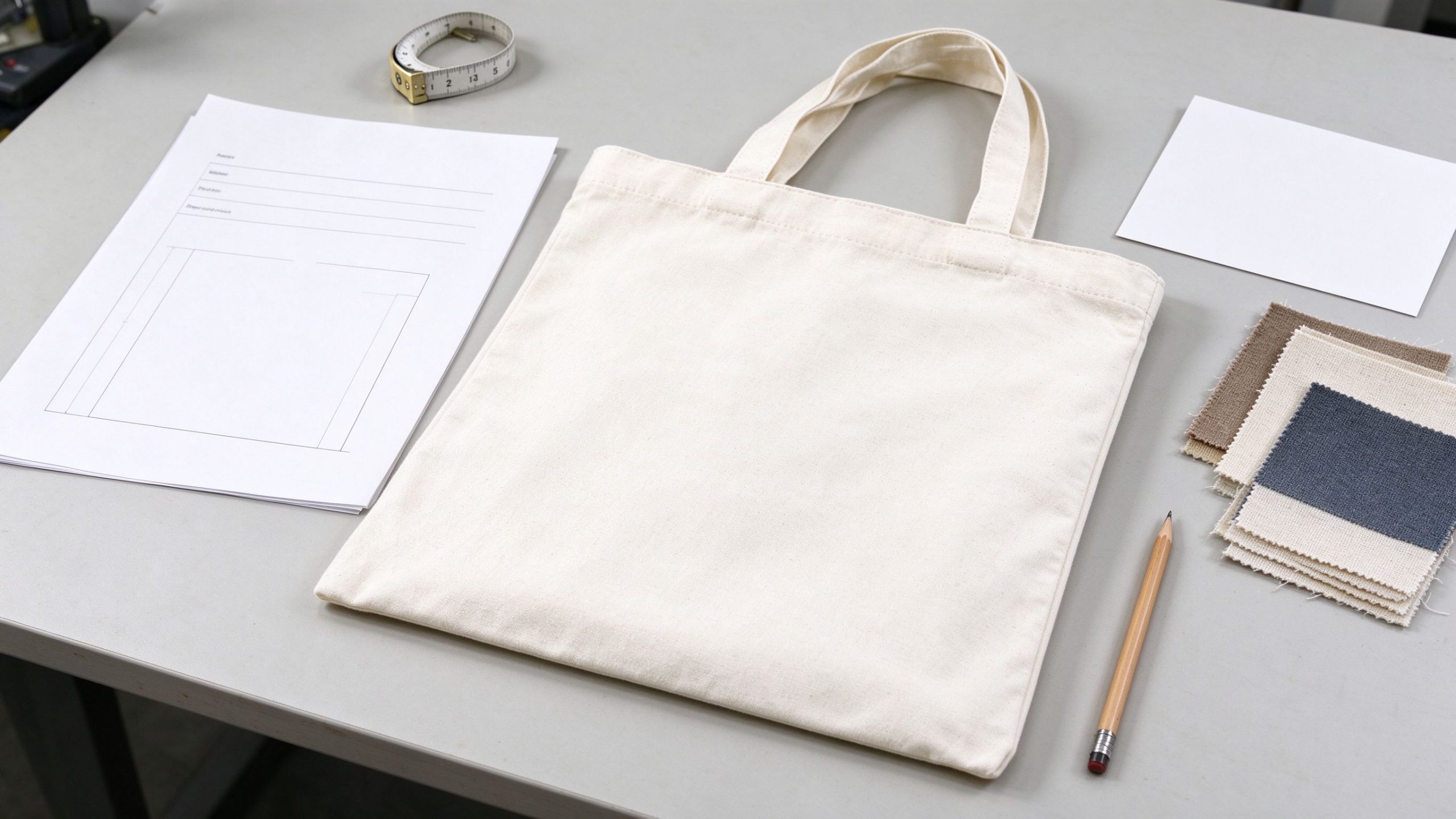
A design file or specification sheet cannot show every detail of a finished bag. Material texture, stitch density, handle attachment, print appearance, and overall proportions all look different once the design becomes a physical product.
It exposes specification gaps
A sample reveals which details were missing from the original brief: an opening too narrow for the intended contents, a pocket that interferes with the main compartment, or a handle drop that does not suit shoulder carrying. Finding these issues on one sample is far cheaper than finding them on a thousand finished bags.
It validates the logo on the actual fabric
A logo that looks sharp on screen may spread, shrink, or lose contrast on textured canvas. The physical sample shows how the artwork behaves on the selected fabric and printing method, so adjustments happen before production rather than after.
It creates an approval reference
An approved sample becomes the physical reference for the agreed design and construction. It should be supported by a written specification, approved artwork, and quality criteria. A sample alone does not guarantee that every unit in a bulk order will be identical, but it gives both sides a common baseline to inspect against.
2. Prepare the Requirements Before Requesting a Sample
The more clearly you describe the required product, the easier it is for a supplier to assess the request and identify missing information. Prepare the following details before asking for a custom canvas tote bag sample.
Product dimensions
Specify the required width, height, and depth, and clarify whether the measurements refer to the main bag body or include handles and gussets. If the bag has a gusset, describe how its depth should be measured. For a flat bottom, boxed corners, or an unusual shape, provide a drawing or reference photograph. Do not rely on a general description such as “medium tote bag” — different suppliers interpret that phrase differently. For guidance on defining finished dimensions, see our custom canvas tote bag sizes guide.
Canvas fabric requirements
Describe the intended fabric as precisely as possible: composition, weight or thickness, surface texture, colour, hand feel, and any coating or finishing treatment. If you do not know the exact technical specification, provide a reference sample, product photograph, or description of the desired appearance. Ask the supplier to confirm which material specification will be used for the sample, and check the material against the points covered in our canvas tote bag fabric quality checklist.
Handles and construction
Specify handle material, length, width, colour, and attachment style. Identify any required pockets, closures, reinforced areas, binding, labels, or decorative details. These features affect both appearance and construction, so include them in the initial specification rather than requesting them after the sample has been made.
Logo and artwork
Prepare the logo file and explain how it should appear: preferred dimensions, print location, colours, orientation, and any design restrictions. If the artwork includes fine lines, small text, gradients, or multiple colours, tell the supplier before sampling so the proposed printing method can be evaluated. Where exact brand colours matter, provide the relevant colour references and agree on how the physical result will be reviewed.
Intended use and target market
Explain whether the tote bag is intended for retail sales, corporate gifting, employee welcome kits, trade shows, or another application. This context helps the supplier understand which details deserve attention. A retail product may require more attention to packaging and visual consistency, while a conference bag may prioritise document capacity and practical handling. If the product must comply with specific market requirements, identify them at the quotation or sampling stage and ask the supplier to confirm what documentation or testing evidence is available.
3. The Custom Canvas Tote Bag Sampling Process
A structured sampling process helps both parties understand what must happen before a bulk order can proceed.
Step 1: Submit a complete sample request
Send the supplier your design files, dimensions, material preferences, logo requirements, and reference images. If you already have a physical sample or an existing bag that closely matches your intended design, ask whether it can be used as a reference. Clearly separate mandatory requirements from preferences: a specific logo position may be essential, while a small variation in an unbranded internal detail may be acceptable.
Step 2: Confirm the proposed specifications
Before sample production begins, review the supplier’s written understanding of your requirements. Confirm the bag dimensions, fabric specification, colour, handle construction, printing method, and finishing details. Ask the supplier to identify any details that cannot yet be confirmed. If the requested fabric or printing process is unavailable, evaluate an alternative before the sample is made.
Step 3: Confirm the sample scope and cost
Ask what the sample arrangement includes. Depending on the project, it may involve an existing reference bag, a modified sample, a newly developed prototype, or a sample with custom printing. Clarify whether the quoted sample cost covers materials, pattern or construction development, logo application, packaging, and delivery, and confirm any additional charges for revisions. Sample fees, available options, and fee credits toward a bulk order are supplier-specific commercial terms — obtain written confirmation rather than assuming a standard arrangement.
Step 4: Review the first sample
When the sample arrives, compare it with the written specification and artwork. Inspect the dimensions, material appearance, handle construction, seams, pocket placement, logo position, and finishing details. Check the bag in realistic conditions relevant to its intended use. Record all differences in a single inspection document, and use annotated photographs to communicate required changes clearly.
Step 5: Request revisions when necessary
A revision should identify the exact issue and the desired correction. Instead of saying “the logo looks wrong,” specify whether it is too large, too low, incorrectly centred, visually distorted, or different from the agreed artwork. Instead of saying “the bag feels different,” explain which material characteristic is unsatisfactory and ask the supplier to propose a measurable adjustment. When a change affects other parts of the design, ask whether it could influence dimensions, construction, appearance, or cost. Keep a revision history so both parties know which sample version is being evaluated.
Step 6: Approve the final sample in writing
Once the sample meets the agreed requirements, issue written approval identifying the approved version. Record the sample date or reference number, the relevant specification sheet, artwork version, fabric details, and any agreed exceptions. If the supplier retains the physical sample, clarify how it will be identified and used as a production reference. If you retain the sample, consider how the supplier will access the same reference during production and inspection. Do not approve a sample with unresolved critical differences merely to keep the order moving — record any accepted variation explicitly.
Step 7: Confirm the bulk production requirements
Sample approval is not a substitute for a complete purchase specification. Before production starts, confirm the order quantity, final unit specification, artwork, packaging, quality inspection criteria, delivery arrangement, and any agreed production milestones. Ask how changes made after sample approval will be handled, and determine whether a revised sample or additional approval is required before proceeding.
4. How to Inspect a Custom Canvas Tote Bag Sample
Use a consistent checklist rather than relying only on whether the sample looks attractive.
Dimensions and shape
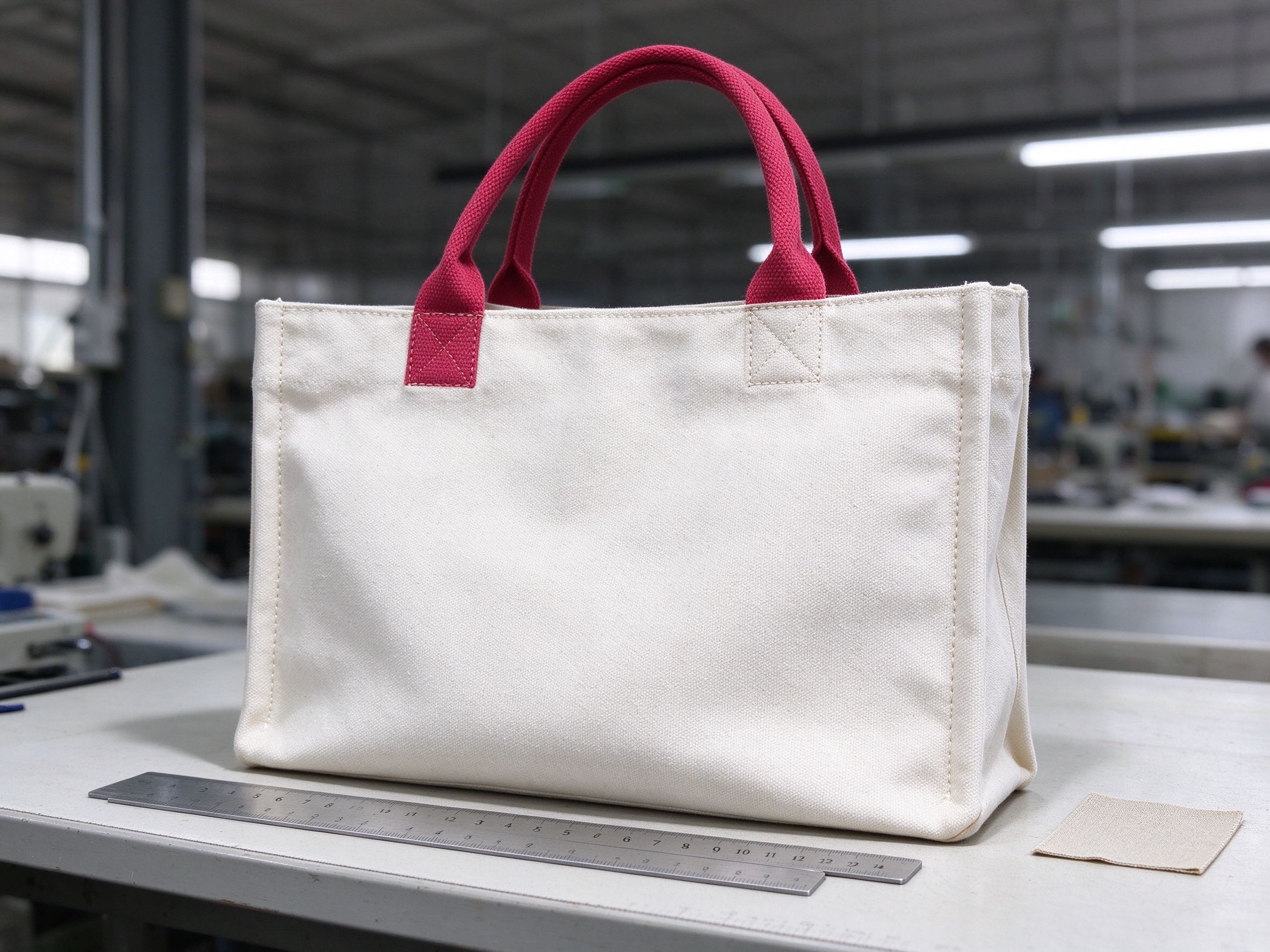
Measure the bag according to the agreed measurement method: width, height, depth, opening, handle drop, and placement of pockets or other features. If the bag is expected to hold a particular type of item, test the fit with a representative item. Compare the results with the agreed tolerances. If no tolerances have been specified, establish them with the supplier before approving the sample.
Fabric and colour
Review the fabric against the approved material description or reference. Check surface appearance, texture, colour, and general consistency, and look for visible defects or unexpected differences. If colour matching is important, evaluate the sample under suitable lighting and agree on an appropriate reference — a photograph alone may not establish an exact colour match.
Stitching and handle attachment
Inspect seams, corners, handle attachment points, and reinforced areas. Look for skipped stitches, loose threads, uneven seam lines, or construction details that differ from the approved design. If the bag is intended for a defined load or use condition, specify the relevant performance requirement and agree on a test method with the supplier. Do not infer a safe carrying capacity from appearance alone.
Printing and branding
Compare the physical logo with the approved artwork: position, scale, orientation, visible edges, colour appearance, and consistency with the agreed printing method. Look for smudging, incomplete coverage, unwanted marks, or other defects relevant to the chosen process. Confirm that any small text or fine design elements remain sufficiently clear for the intended application.
Finishing and packaging
Inspect loose threads, edge finishing, labels, closures, and other specified details. If the bags will be sold at retail or delivered as corporate gifts, review the proposed packaging as part of the sample process when packaging affects the customer-facing presentation. Photograph significant defects and record whether each item is acceptable, requires correction, or needs further discussion.
5. Common Sampling Mistakes to Avoid
Providing only a product photograph. A photograph communicates general style but may not show dimensions, fabric details, construction, or print requirements. Use photographs as references and supplement them with measurements, written specifications, and artwork files.
Changing the design during sampling without updating the specification. If the logo, material, handle, or dimensions change, update the specification and identify the new version. Otherwise the supplier may work from an outdated file or misunderstand which details have been approved.
Reviewing the sample without measurable criteria. Statements such as “make it stronger” or “use better material” are difficult to evaluate consistently. Describe the required improvement and agree on the relevant specification, inspection method, or performance criterion wherever possible.
Assuming the sample represents every production unit. A sample demonstrates a particular version of the product. It does not establish that every unit in a bulk order will be identical. Define the production specification, acceptable variation, inspection process, and response to nonconforming goods before placing the order.
Approving before all important details are settled. A visually acceptable bag may still have unresolved issues involving printing, packaging, dimensions, or construction. Use a final approval checklist to ensure that the relevant requirements have been reviewed and documented.
6. What Affects the Sampling Timeline
There is no single sampling timeline that applies to every project. The time required depends on the completeness of the initial specification, material availability, design complexity, printing method, sample workload, shipping arrangements, and the number of revision rounds. A project using an available reference design may follow a different process from one requiring a new construction pattern or several custom features.
To plan realistically, ask the supplier to confirm: when the sample can enter development, whether the required materials are available, the expected sample completion date, whether logo application is included in the initial sample, how long revisions may take, the estimated shipping time, and which decisions or approvals are required from the buyer. Request a timeline that distinguishes sample preparation, buyer review, revisions, and delivery, and treat any estimate as supplier-specific until confirmed in writing. For event or seasonal orders, build in time for feedback and possible revisions rather than scheduling bulk production around an unapproved sample.
7. Custom Canvas Tote Bag Sample Approval Checklist
Before approving a sample, review the following points.
Product specifications
- Dimensions match the agreed specification
- Fabric type, appearance, and colour have been reviewed
- Handle design and attachment match the approved requirements
- Pockets, closures, labels, and other features are correctly positioned
- Relevant finishing details have been inspected
Branding
- The correct artwork version was used
- Logo size, position, and orientation are acceptable
- Colour appearance and print quality have been reviewed
- Any agreed artwork limitations or variations are documented
Quality requirements
- Visible construction defects have been recorded
- Required performance criteria and test methods have been agreed where applicable
- Acceptable tolerances are documented
- Any unresolved issues have been assigned for correction
Commercial and production details
- Sample charges and revision terms are understood
- Packaging requirements have been confirmed where applicable
- The approved sample or reference version is identifiable
- The final production specification matches the approved sample
- Changes after approval require documented agreement
When all relevant points have been reviewed, send written approval to the supplier and retain a copy with the purchase documentation.
Frequently Asked Questions
Is a sample necessary before ordering custom canvas tote bags in bulk?
A sample is useful when the project involves custom dimensions, new artwork, specific construction requirements, or a significant bulk commitment. For a standard product, a reference sample may be sufficient, depending on the buyer’s risk tolerance and the supplier’s process. The appropriate approach depends on the complexity of the product and the consequences of a specification error.
What information should I provide for a custom canvas tote bag sample?
Provide dimensions, fabric preferences, handle requirements, colour references, logo artwork, print placement, finishing details, intended use, and reference images where available. If some specifications are not yet known, identify them clearly and ask the supplier to recommend options for evaluation.
How many sample revisions should I expect?
The number of revisions depends on the project, the quality of the initial specification, and how closely the first sample matches the agreed requirements. Confirm the supplier’s revision policy and any additional charges before sampling begins. Do not assume that unlimited revisions are included.
Can I approve a sample from photographs?
Photographs can help review logo placement, overall appearance, and certain visible construction details. However, they cannot fully establish fabric texture, dimensions, or every aspect of physical construction. For a new or technically demanding product, a physical sample generally provides a more complete basis for evaluation.
Does an approved sample guarantee bulk production quality?
No. An approved sample establishes a reference for the agreed product, but bulk consistency also depends on production controls, material consistency, inspection criteria, and how deviations are managed. Document the specifications and quality requirements, and agree on a suitable inspection process before production.
Should packaging be included in the sample review?
If packaging affects retail presentation, product protection, labelling, or delivery requirements, include it in the review. Confirm whether the sample includes the intended packaging and whether any packaging changes must be approved separately.
Request a Custom Canvas Tote Bag Sample
A clear sampling process helps buyers identify design issues early, align expectations with suppliers, and establish a documented reference before bulk production. If you are sourcing custom canvas tote bags for retail, corporate gifting, trade shows, or promotional programs, prepare your product requirements before requesting a quotation or sample.
To discuss your project with BriefcaseCustom, send your target bag dimensions and intended use, the preferred canvas fabric and colour, your logo or artwork file, required handles, pockets, closures and finishing details, the estimated order quantity and target delivery date, and any reference photographs or physical samples. Contact [email protected] with your specifications to discuss available options, sample arrangements, and quotation requirements.
Before bulk production begins, make sure the final sample, artwork, product specification, and approval record are aligned. Browse our custom tote bags range for more product and OEM options, and confirm the sampling and revision policy in writing before approving production.