How to Compare Custom Bag Manufacturer Quotes: A B2B Buyer’s Guide
When three factories send prices for what looks like the same business bag, the lowest number is rarely the best order. Two custom bag manufacturer quotes can use the same product photograph and still describe materially different products — different fabric grade, dimensions, lining, padding, hardware, logo method, packaging, sampling, inspection and shipping terms. The unit price only becomes meaningful once the specification behind it is identical.
This matters especially for business bags: briefcases, laptop bags, messenger bags and conference bags. A small change in material or construction changes the finished product, while a difference in packaging or shipping terms changes the delivered cost. This guide explains what to put into a quotation comparison, which costs are commonly separated, how to spot unclear assumptions, and how to choose between suppliers before placing a bulk order.
1. Why Custom Bag Manufacturer Quotes Are Hard to Compare
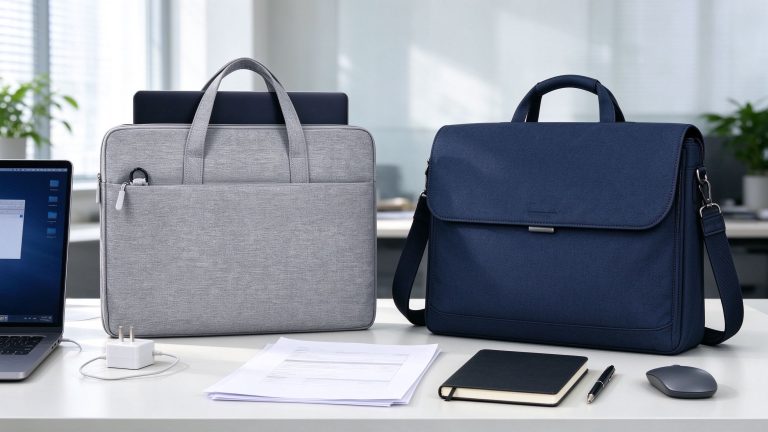
Suppose one manufacturer quotes a business bag using a particular Oxford fabric, standard lining, standard zipper, one logo position and standard packaging at a stated quantity. Another supplier reads the same request differently: lighter fabric, less padding, different hardware, more basic packaging, another logo method and different shipping terms. Both call it a “custom laptop bag,” but the products are not equivalent. The first step in comparing custom bag manufacturer quotes is therefore one specification that every supplier quotes against.
2. Start With the Product Specification
Before comparing prices, make sure every supplier receives the same product brief: bag type, finished dimensions, important internal dimensions, material, colour, lining, laptop compartment requirements, pocket layout, handles, shoulder strap, hardware, closure, logo method and position, packaging, quantity, delivery destination and required delivery date. For a laptop bag, provide the actual laptop dimensions rather than only “15.6-inch” — the laptop bag size guide explains why devices with the same screen label can have very different physical sizes.
3. Compare Material Specifications, Not Just Material Names
“Oxford fabric” is not a complete material specification. Ask suppliers to clarify fabric type, density or weight, coating or treatment, lining material, padding, webbing, accent materials and colour reference. The same applies to nylon, polyester, canvas and PU. If two quotations do not state the same material specification, their unit prices are not directly comparable.
For example, two quotes can both say “Oxford fabric” while one uses 600 denier PU-coated material and the other a lighter 300 denier weave. The difference affects water resistance, abrasion resistance, drape, print quality and the bag’s empty weight. Ask each supplier for the same data points — fabric construction, weight in grams per square metre or denier, backing or coating, and the colour reference used for dyeing — so material becomes a comparable line in your table rather than a word everyone interprets differently. The business-briefcase materials guide on this site similarly recommends specifying the actual fabric rather than relying on broad category names, because material choice drives weight, structure, print quality and cost.
4. Compare the Finished Dimensions
A supplier quoting 40 × 30 × 8 cm and another quoting 40 × 30 × 10 cm may look almost identical, but the difference affects internal capacity, laptop compatibility, document storage, bag weight, packaging volume, shipping cost and visual proportions. Compare both external dimensions and internal usable space, especially when the bag must carry a laptop, A4 documents, charger, notebook, samples or conference materials. Extra capacity is not automatically better — it can increase bulk and freight without real utility.
5. Check What Is Included in the Laptop Compartment
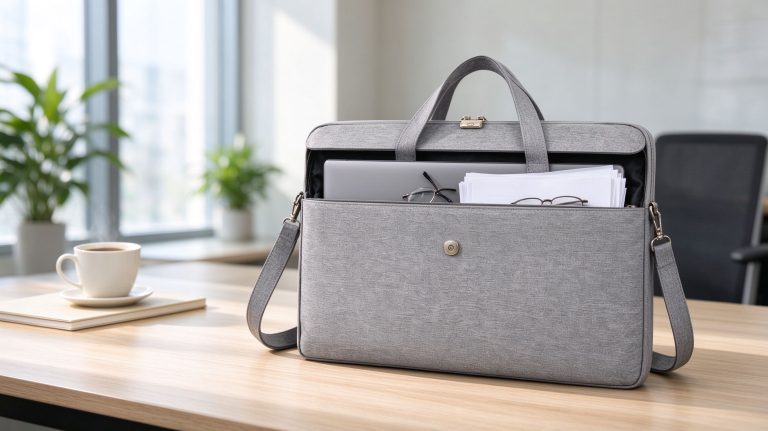
For laptop bags, the compartment is its own specification. Ask suppliers to confirm internal length, width and depth, padding thickness, bottom protection, divider construction, closure method, and whether the compartment is fixed or removable. State whether the laptop will travel bare, in a sleeve or in a hard case. A quotation with padded laptop protection is not equivalent to one with a thinner or differently structured compartment, and the actual device should be used during sample testing.
6. Compare Pocket Layout, Handles and Straps
Pocket count alone is not a quality measure — a bag with five well-positioned compartments can outperform one with twelve random ones. Agree the layout: main compartment (laptop, documents, notebook), front compartment (phone, business cards, pens), internal organiser (charger, cables, mouse), rear compartment (A4 documents, travel papers). Then check carrying components: handle material, length and reinforcement; strap width, padding, adjustment and hardware; and whether the strap and hardware shown in the reference photo are actually included. For messenger and shoulder bags, the strap is a functional component, not decoration.
7. Compare Zippers, Hardware and Logo Application
Hardware is a small part of the price but affects appearance, function, weight and brand perception. Ask whether the quote includes the main zipper, pocket zippers, pulls, D-rings, buckles, adjusters, metal logo plates and feet — and name a required hardware brand or finish if you need one. Logo application must be quoted separately too: “custom logo included” is not enough. State the method (screen print, heat transfer, embroidery, woven label, rubber patch, metal badge), logo size, position, number of colours and number of locations. A front-panel one-colour print is not equivalent to a front logo plus side label and interior branding. For defining the logo and decoration requirements before sending enquiries, see custom bags with logo.
8. Compare Packaging and Shipping Terms
Packaging is frequently left out of early comparisons: individual polybag, dust bag, hangtag, label, carton size and quantity, carton markings, retail packaging and pallet requirements. A quotation excluding individual packaging looks cheaper until packaging is added later. On commercial terms, compare EXW, FOB, CIF or DDP explicitly. Never compare Supplier A’s delivered cost with Supplier B’s factory price as if they were the same number. The landed cost is product + logo + packaging + sampling + inspection + freight + duties — and not every order includes every line.
9. Compare MOQ, Sampling and Quality Control
Ask what quantity each quote is based on, whether MOQ applies per style, per colour or per logo, whether colours can be mixed, and whether the price holds for one run or multiple runs. An RFQ for 1,000 pieces should not be compared with one based on 500. On sampling, confirm sample fee, shipping, production time, whether the fee is refundable, and whether the sample uses final material, colour, logo, hardware, layout and packaging. On quality control, “QC included” is not a specification — define what gets checked: material match, colour, stitching, zippers, handles, compartment fit, logo quality and packing against the approved sample.
Also ask whether inspection is done by the factory itself, by a third-party inspector, or by your own team, and what documentation you receive — a packed-goods report, measurement records or photo evidence. A supplier that quotes an external inspection adds cost, but the independent report can reduce the risk of a failed bulk run. Either way, the inspection standard should be agreed before production starts, not negotiated after a problem appears.
“Lead time” means different things: production after sample approval, order to factory completion, or order to delivery. Ask suppliers to separate sample development, sample approval, material preparation, bulk production, inspection, packing and shipping. Record deposit percentage, balance timing, payment methods and tooling or setup charges. Finally, ask directly: “What additional costs could appear if we approve this specification?” — pattern development, moulds, screen setup, custom pulls, colour matching or sample revisions can all be missing from an attractive-looking quote.
11. Build a Like-for-Like Quote Comparison Table
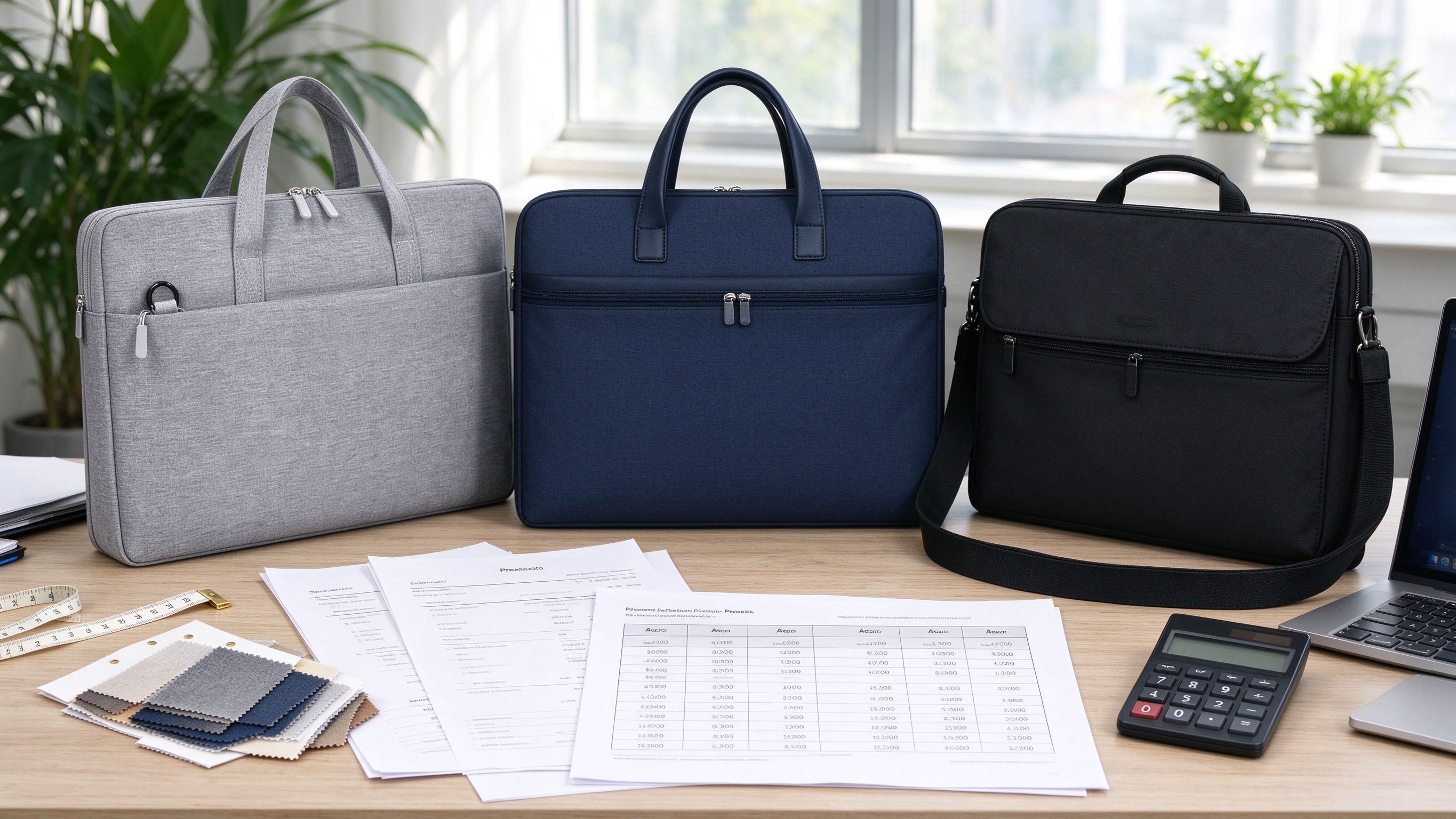
Put every quotation into one table: product style, quantity, material, lining, dimensions, laptop compartment, padding, pocket layout, handles, strap, hardware, logo method, logo locations, packaging, sample cost, sample lead time, production lead time, MOQ, payment terms, inspection, shipping term, freight and estimated landed cost, plus the in-hand date. This table usually reveals why two “identical” quotes are not actually identical. For a briefcase-focused walkthrough of this process, the article on comparing wholesale briefcase quotes on a like-for-like basis covers the same method for briefcase buyers.

12. When a Cheap Quote Is the More Expensive One
Unit price matters, but procurement decisions should weigh the complete project cost. A $6 bag with basic padding and no document section is not necessarily cheaper than an $8 bag with the required laptop compartment, file section and packaging, if the $6 product needs modifications later. When comparing custom bag manufacturer quotes, the goal is not the lowest number — it is the lowest credible cost for the required specification. A much lower quote should trigger a specification review, not immediate acceptance: different material, smaller dimensions, less padding, simpler lining, fewer pockets, cheaper packaging, different logo method or different shipping terms can all explain it. The price may be completely legitimate; the problem is not knowing why.
13. How to Request Better Quotes From Bag Manufacturers
Send every manufacturer the same RFQ: product (type, reference image, intended use, target market), size (external and required internal dimensions, laptop dimensions), material (preferred fabric, colour, lining, padding), function (compartments, pockets, handles, strap, closures, hardware), branding (logo file, size, position, method if known), and order details (quantity, colour breakdown, packaging, destination, required in-hand date). Then ask for unit price, sample cost, MOQ, lead time, payment terms, shipping term, estimated freight and any additional charges. A request for quotation follows a standard procurement structure; the Wikipedia overview of the request for quotation process is a useful reference.
14. Proven Model vs Full OEM: Which Do You Actually Need?
Not every project needs a new bag. A proven model suits moderate quantities, standard dimensions, branding-only needs and short deadlines. Full OEM development is worth it when you need unique dimensions, custom pocket layouts, a new laptop compartment, special materials, custom hardware, private-label construction or distinctive packaging. For laptop-focused OEM work, the custom laptop bag manufacturer page covers development around dimensions, materials, hardware, packaging, sampling and quality control. Choose based on the customization actually required — not the assumption that a fully custom bag is always better.
15. A 10-Point Quote Evaluation Checklist
- Same product specification
- Same material and lining
- Same external and internal dimensions
- Same internal organisation and laptop compartment
- Same logo method and positions
- Same packaging
- Same quantity basis (MOQ)
- Same commercial and shipping terms
- Comparable sample and QC process
- Realistic production and delivery schedule
If any of these differ, normalise the quotations before comparing them — adjust quantities, add missing packaging, convert EXW to landed cost, and request the missing specification details.
16. Frequently Asked Questions
What is a custom bag manufacturer quote?
It is a price a factory provides for producing a custom business bag to a specific specification: material, dimensions, compartments, hardware, logo method, quantity, packaging, lead time and shipping terms. The quote is only meaningful when the specification behind it is clear.
Why do two quotes for the same bag differ so much?
Usually because the suppliers assumed different materials, dimensions, padding, logo methods, packaging or shipping terms, not because one factory is simply cheaper. Comparing custom bag manufacturer quotes requires normalising those assumptions first.
Should I choose the lowest quote?
Not automatically. A competitive quote is a clear, specification-based price for a product that arrives as described, with a workable sample, QC and delivery plan. The cheapest quote can be the best decision when it represents an equivalent product — or the most expensive one later if corners were cut.
17. Final Takeaway
The difference between a good quote and a cheap one is transparency. A strong quotation is clear, comparable, specification-based, complete enough to identify major costs, realistic about production, and backed by a meaningful sampling process. When comparing custom bag manufacturer quotes, the central question is: what finished product will actually arrive at the stated price? Define the bag first, send one specification to multiple manufacturers, normalise the quotations, list excluded costs, approve a representative sample, and compare suppliers on price and production risk together. That approach works across custom briefcases, laptop bags, messenger bags and conference bags — exactly where dimensions, internal organisation, branding and packaging vary most even when suppliers use the same product name.