Canvas Tote Bag Weight Guide: What Bulk Buyers Need to Know
When sourcing custom canvas tote bags for retail, corporate gifts, trade shows, or promotional campaigns, weight is an important specification to consider. It affects the feel of the finished bag, shipping calculations, storage requirements, and how the product fits its intended use.
However, the term canvas tote bag weight can refer to several different measurements. A supplier may discuss fabric weight, while a buyer may be asking about the weight of a finished empty bag. Neither measurement automatically tells you how much the bag can carry.
For wholesale and OEM buyers, the best approach is to define each measurement separately, evaluate the complete bag construction, and confirm the requirements with an approved sample.
This guide explains the main factors affecting canvas tote bag weight and provides a practical checklist for specifying products and checking bulk orders. Explore our custom canvas tote bags to review the available design and customization options for your project.
1. What Does Canvas Tote Bag Weight Mean?
Before requesting a quotation, establish which type of weight you need to compare.
Fabric weight
Fabric weight describes the weight of the textile itself, usually expressed in grams per square metre (GSM).
GSM is useful when comparing fabric specifications, but it is not the weight of an entire tote bag. Two bags made from fabrics with different GSM values may also differ in weave, thickness, coating, composition, and construction. Consequently, GSM alone does not establish which finished bag will be heavier, more durable, or more suitable for a particular application.
When requesting fabric information, ask the supplier to identify the material, construction, nominal GSM, and measurement method where applicable.
Finished empty bag weight
Finished empty bag weight refers to the weight of the completed bag without its contents.
Depending on the specification, the finished product may include:
- Main body fabric
- Handles
- Side gussets and bottom panels
- Inner pockets
- Closures and other accessories
- Printed or decorated areas
- Labels and additional reinforcements
For a fair comparison, make sure each supplier is quoting the same product configuration. A basic open-top tote and a tote with a reinforced bottom, long shoulder straps, and an internal pocket should not be treated as identical products simply because their external dimensions are similar.
Packaging weight
Packaging introduces another measurement. An individual retail package, protective bag, carton, or shipping case adds weight to the shipment. Buyers calculating freight requirements should distinguish the empty product weight from the packaged unit weight and total shipment weight.
Ask your supplier to identify which measurement appears on the quotation and packing information.
Carrying capacity
Carrying capacity concerns the load a bag can safely support under defined conditions. It is not equivalent to fabric GSM or empty bag weight.
A heavier bag may contain more fabric, reinforcement, or accessories, but these characteristics do not independently establish its safe carrying capacity. Stitching, handle attachment, seam construction, fabric properties, and the distribution of the load all matter.
If carrying capacity is important to your application, define the intended load and request an appropriate test procedure and documented results.
2. What Factors Affect the Weight of a Canvas Tote Bag?
The finished weight of a custom canvas tote depends on the complete product specification.
Fabric composition and GSM
Fabric selection is one of the main factors affecting weight. Canvas may be produced using different fibres and fabric constructions. Even when two fabrics have similar nominal GSM, their thickness, weave, surface texture, and finishing may differ.
When comparing supplier quotations, request the actual proposed fabric specification rather than relying on descriptions such as “heavy canvas,” “premium canvas,” or “thick material.” These terms are not sufficiently precise for procurement.
Your specification should identify:
- Fibre composition, where known and relevant
- Fabric construction
- Nominal GSM
- Colour and finishing requirements
- Any coating or treatment
- Whether the specification refers to the fabric before or after finishing
Ask the supplier to clarify any differences between the stated specification and the material used for the approved sample.
Bag dimensions
Larger bags generally require more material when other construction details remain comparable. However, dimensions alone do not determine finished weight. A bag’s depth, gusset design, handle length, pocket configuration, and reinforcement can change the amount of material used.
For a meaningful comparison, record the finished width, height, and depth, along with any handle or pocket dimensions relevant to the design. Specify whether measurements refer to the finished bag and how they should be taken.
Handles and reinforcement
Handle construction can affect both the finished weight and the bag’s performance. Common design variables include:
- Handle material
- Handle width and length
- Single-layer or reinforced construction
- Stitching pattern and attachment method
- Additional reinforcement panels
- Intended carrying method
A long shoulder handle and a short hand-carry handle may use different amounts of material. Reinforcement may also add weight while serving a functional purpose. Do not remove reinforcement simply to reduce product weight without considering the bag’s intended use and required performance.
Gussets and bottom panels
Side gussets and bottom panels create additional usable space, but they also introduce additional material and seams. A flat tote without gussets has a different construction from a box-shaped bag with a defined bottom.
When comparing samples, check whether the bags use the same gusset depth, bottom construction, and reinforcement. Otherwise, a weight difference may result from the design rather than the fabric specification.
Pockets, closures, and accessories
Additional features can affect finished weight, including:
- Internal or external pockets
- Zippers and buttons
- Magnetic closures
- Decorative labels
- Metal accessories
- Lining materials
- Additional compartments
Each feature should be included in the approved product specification. For bulk orders, avoid comparing a sample with multiple accessories against a quotation for a basic tote without confirming which features are included.
Printing and decoration
Printing and decoration can also change the finished product, although the effect depends on the process, artwork, and materials used. A large printed area, multiple print locations, embroidery, or additional decorative components may produce a different result from a plain bag.
Do not assume that all printing methods add the same weight. If the difference matters to your shipping calculations or product specifications, weigh a finished decorated sample rather than estimating the effect from the artwork alone.
3. How to Specify Canvas Tote Bag Weight for a Wholesale Order
A clear specification helps suppliers quote the intended product and reduces the risk of receiving bags that differ from the approved sample.
Step 1: Define the intended application
Start with the bag’s primary use. For example, a retailer selling reusable shopping bags may prioritise appearance, repeat use, and shelf presentation. A trade show organiser may focus on carrying printed materials and distributing bags efficiently. A corporate gifting programme may require additional pockets or a more structured design.
These applications can lead to different requirements. Avoid choosing fabric weight before establishing the bag’s dimensions, construction, intended use, and design features.
Step 2: Specify the fabric separately
Record the requested material and GSM as distinct specifications. If you are open to alternatives, ask the supplier to quote clearly identified options. Each option should state its fabric specification and any differences in construction or finishing.
Do not accept a comparison that changes both the fabric and the bag design without identifying those changes.
Step 3: Define the finished bag
Document the complete configuration, including:
- Finished dimensions
- Handle length and width
- Gusset and bottom design
- Pocket and closure details
- Reinforcement requirements
- Printing or embroidery
- Labels and accessories
- Individual packaging, if required
This information provides the basis for comparing samples and quotations.
Step 4: Request a finished sample
A sample allows you to evaluate the actual combination of material, dimensions, construction, and decoration. Record its measured empty weight and retain the approved sample or an agreed reference record.
If the sample is weighed before printing or after adding accessories, document that condition clearly.
Step 5: Agree on the measurement method
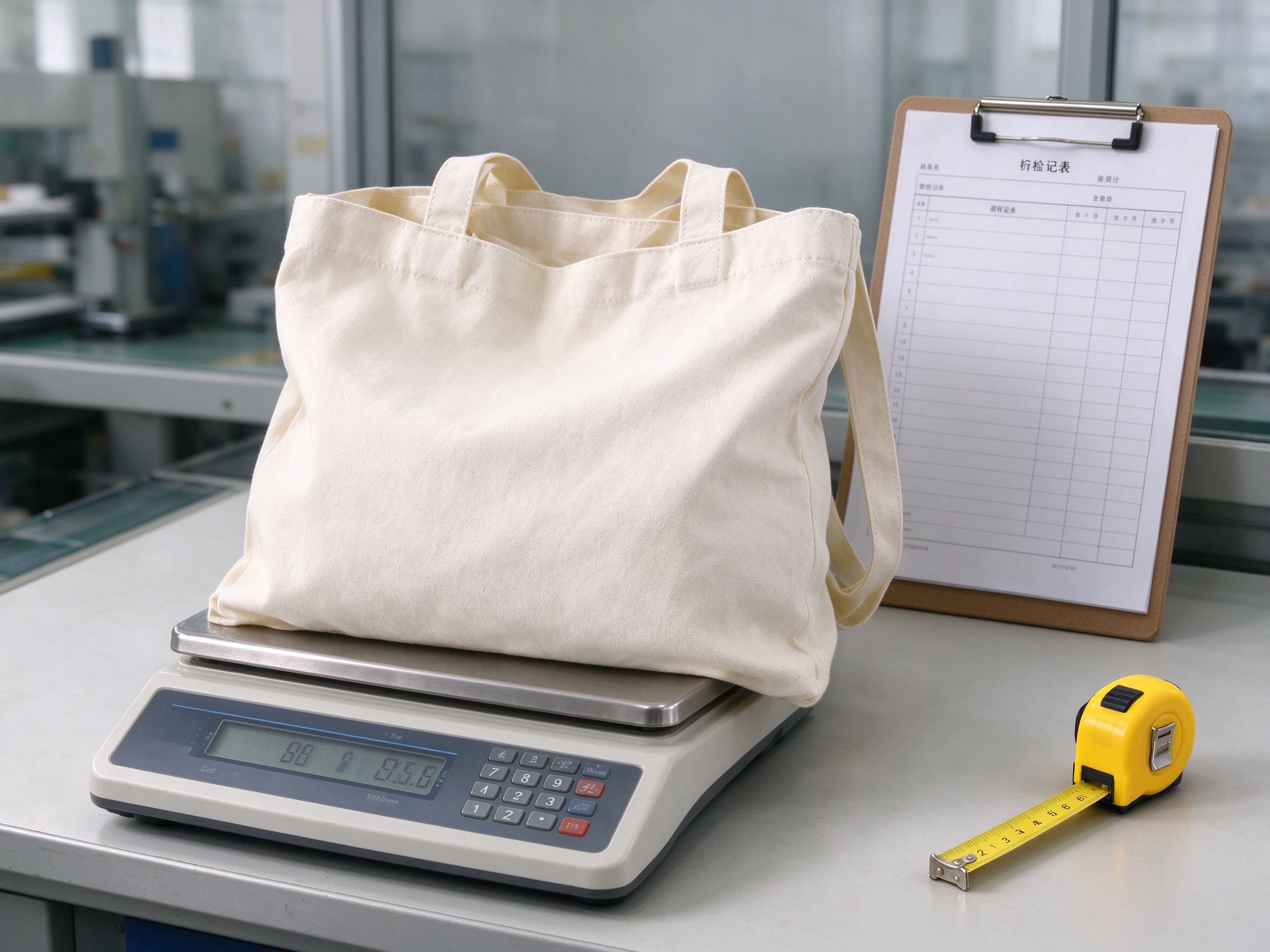
Before production, agree with the supplier on how finished bag weight will be measured. For example, establish whether the bag must be empty, dry, and free of removable packaging. Define whether labels and permanent accessories are included.
If a particular tolerance is required, agree on the acceptable range and measurement procedure in writing. The tolerance should be based on the product specification and the buyer’s requirements, not an assumed universal industry standard.
Step 6: Verify production consistency
During production or final inspection, compare representative bags against the approved specification. Check the fabric identification, dimensions, construction, decoration, and measured weight.
A weight difference does not automatically prove a defect, but an unexplained difference may indicate a change in fabric, dimensions, accessories, or construction. Investigate the cause before approving the shipment if the deviation could affect product quality or compliance with the purchase order.
4. How to Compare Canvas Tote Bag Weight Across Suppliers
When comparing quotations, use a consistent specification sheet.
| Comparison item | What to request | Why it matters |
|---|---|---|
| Fabric composition | Identified fibre composition, where available | Helps distinguish material options |
| Fabric GSM | Nominal value and measurement basis | Supports fabric specification comparison |
| Finished dimensions | Width, height, and depth | Helps establish the amount and layout of material |
| Handle construction | Material, width, length, and attachment details | Clarifies construction differences |
| Gusset and bottom | Design and reinforcement details | Explains differences in shape and material use |
| Accessories | Pockets, closures, labels, and other features | Prevents incomplete comparisons |
| Printing | Method, location, and artwork coverage | Identifies decoration differences |
| Finished empty weight | Measured sample weight and agreed method | Enables like-for-like product comparison |
| Packaging | Packaging configuration and unit weight, if required | Supports shipping calculations |
| Quality requirements | Inspection criteria and agreed tolerances | Establishes acceptance conditions |
Ask each supplier to complete the same table. If one quotation specifies fabric GSM while another gives only a finished bag weight, request clarification before comparing the offers. The two measurements answer different questions.
Likewise, a lower finished weight should not automatically be treated as better value. Determine whether the difference comes from an intentional design choice or an unapproved material or construction change.
5. How to Check Finished Bag Weight During Sample Approval
Sample approval is the best opportunity to align the buyer’s expectations with the supplier’s production specification. Use the following procedure.
- Confirm the sample identity. Record the model, material, colour, dimensions, and design revision.
- Confirm the weighing condition. Specify whether the sample is empty and whether permanent labels, accessories, and decoration are included. Exclude removable packaging if the requirement is for the empty product.
- Use a suitable scale. Select a scale with sufficient capacity and resolution for the expected product weight. Check that it is functioning correctly and follow the agreed measurement procedure.
- Record the result. Document the measured weight, measurement date, sample identification, and any relevant conditions.
- Compare the complete specification. Check dimensions, fabric, handles, gussets, reinforcement, printing, and accessories. Do not investigate weight in isolation.
- Approve the reference sample. Keep a retained sample, approved specification sheet, or other agreed reference for comparison with production.
- Define how deviations will be handled. Specify the agreed tolerance, inspection approach, and corrective-action process before bulk production begins.
For larger orders, buyers may also request inspection records covering representative production samples. The inspection scope should be agreed with the supplier before the order is placed.
6. How Bag Weight Affects Shipping and Procurement Planning
Finished bag weight is relevant to logistics, but it is only one part of the calculation.
For shipment planning, distinguish among:
- Product weight: The weight of the specified bag without removable packaging.
- Packaged unit weight: The product plus its individual packaging, where applicable.
- Gross carton weight: The packed products plus the shipping carton and its contents.
- Shipment gross weight: The combined gross weight of all shipping packages.
- Dimensional considerations: The space occupied by the packed shipment.
Actual freight calculations depend on the carrier, service, route, packaging dimensions, and applicable rating rules. Do not estimate freight solely from the weight of one empty bag.
Request packaging specifications and carton measurements when preparing a purchase order. For a large shipment, ask the supplier to confirm the expected packing configuration and provide verified packing information when available.
If you are comparing two bag designs, evaluate both the product specification and the packed shipping configuration. A lighter individual bag may not necessarily result in a proportionally lower shipping cost if the packaging or shipment volume differs.
7. Common Mistakes When Evaluating Canvas Tote Bag Weight
Avoid these common procurement errors.
Mistake 1: Treating GSM as finished bag weight. GSM describes fabric weight per unit area, not the total weight of a completed product.
Mistake 2: Assuming a heavier bag is always better. A higher weight does not independently prove better workmanship, durability, or carrying capacity.
Mistake 3: Comparing products with different dimensions. Differences in width, height, depth, and construction can make a direct weight comparison misleading.
Mistake 4: Ignoring handles and reinforcement. These components can materially change the construction and the final measurement.
Mistake 5: Weighing samples with different accessories. A fair comparison requires the same product configuration and weighing conditions.
Mistake 6: Setting an arbitrary tolerance. Agree on a product-specific tolerance and measurement method rather than assuming a universal acceptable variation.
Mistake 7: Changing specifications after sample approval. Any change to fabric, dimensions, reinforcement, or decoration should be reviewed and approved when it could affect the finished product.
8. Canvas Tote Bag Weight Checklist for Bulk Buyers
Before confirming a wholesale or OEM order, check that you have documented the following:
- Intended application and end user
- Fabric composition, where specified
- Fabric GSM and measurement basis
- Finished bag dimensions
- Handle material, dimensions, and attachment
- Gusset, bottom, and reinforcement construction
- Pocket, closure, and accessory requirements
- Printing or embroidery specifications
- Approved sample and revision identification
- Finished empty bag weight and weighing method
- Agreed weight tolerance, if applicable
- Inspection procedure and acceptance criteria
- Individual packaging and carton specifications
- Shipment packing information
- Process for approving specification changes
If any item remains undecided, clarify it before approving the final sample or placing the production order.
Frequently Asked Questions
Does higher GSM always mean a heavier canvas tote bag?
No. GSM measures the weight of fabric per square metre. Finished bag weight also depends on fabric area, construction, handles, gussets, reinforcement, pockets, and accessories. Compare the actual fabric specification and completed product separately.
Can I estimate a tote bag’s weight from its dimensions?
Dimensions help explain differences between bags, but they are not enough to establish an accurate finished weight. Material specifications and construction details are also required. Request a sample measurement for a more reliable result.
Does a heavier canvas tote bag have a higher carrying capacity?
Not necessarily. Carrying capacity depends on the complete construction and the performance of the fabric, seams, handles, and attachment points. If a defined load is required, request an appropriate test method and documented results.
Should the quoted weight include packaging?
That depends on the purpose of the quotation. For product comparisons, request the finished empty bag weight separately. For logistics planning, request individual packaged weight and carton gross weight where applicable.
How should I set an acceptable weight tolerance?
Agree on the tolerance with your supplier based on the approved product specification, measurement method, and intended application. Document the acceptable range before production rather than applying an assumed industry-wide value.
What information should I send when requesting a custom canvas tote bag quotation?
Provide the intended use, finished dimensions, fabric requirements, handle and gusset details, artwork, accessories, packaging requirements, order quantity, and any specific weight or performance criteria. Ask the supplier to identify any assumptions or proposed substitutions in the quotation.
Request a Custom Canvas Tote Bag Quotation
Planning a wholesale order of custom canvas tote bags? A complete specification helps suppliers evaluate your requirements and provide a more useful quotation.
Send your proposed dimensions, fabric requirements, handle design, printing artwork, packaging preferences, and order quantity. If finished bag weight is important to your project, specify whether you mean the empty product weight or packaged unit weight.
Our team can review the requested configuration and clarify which specifications need to be confirmed before sample approval. Browse our custom tote bags for more information about product options and OEM requirements. Contact BriefcaseCustom to discuss your custom canvas tote bag requirements and request a quotation.