Satchel Bag vs Messenger Bag for Work: Which Is Better?
The satchel bag vs messenger bag decision for work usually comes down to one practical question: how much of your day is spent walking, and how much is spent in meetings? Someone who commutes, uses public transportation and wants hands-free access tends to prefer a messenger bag. Someone who enters meetings, carries documents and wants to switch between hand and shoulder carrying tends to prefer a satchel. Both can carry laptops and documents well; the difference is that each format is built around a different work pattern.
The difference becomes important when choosing a work bag. Someone who regularly enters meetings, carries documents and wants to switch between hand carrying and shoulder carrying may prefer a satchel. Someone who walks between locations, uses public transportation and wants hands-free access may find a messenger bag more practical.
For companies sourcing bags in bulk, the decision also affects the internal layout, strap construction, laptop compartment, branding area, material selection and packaging. The best choice is therefore not determined by appearance alone. It should begin with what the bag needs to carry and how the recipient will use it.
1. Satchel Bag vs Messenger Bag: The Main Difference
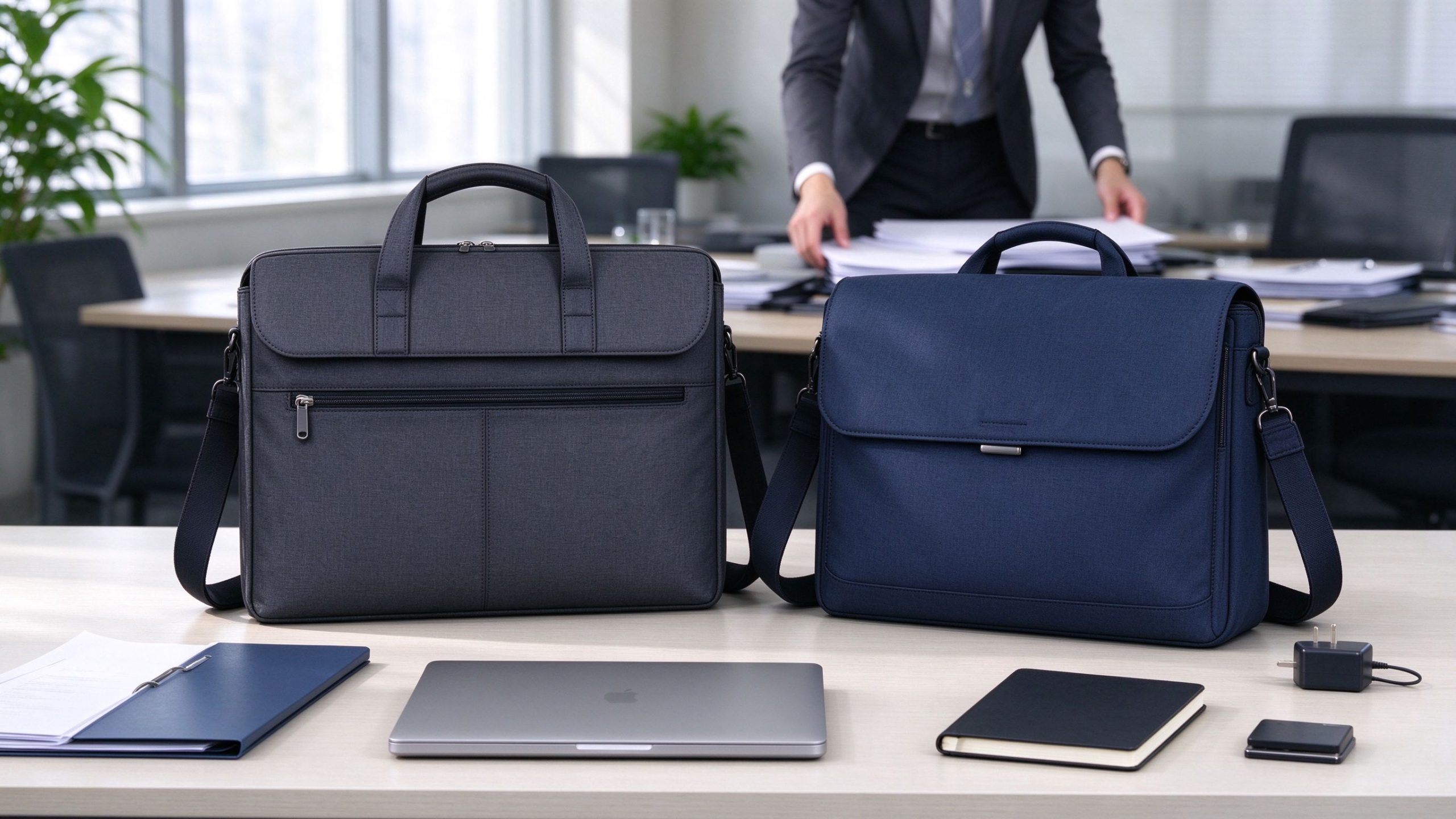
The simplest distinction is the structure and carrying system. A satchel is usually a structured or semi-structured bag with a defined base and one or two top handles. Many modern satchels also include a detachable shoulder strap. A messenger bag is usually designed around a long shoulder strap. It can often be carried on one shoulder or across the body, with the bag positioned near the hip.
There is overlap between the two categories. A satchel can have a crossbody strap, and a messenger bag can have a top handle. Some modern business bags combine features from both.
| Feature | Satchel | Messenger Bag |
|---|---|---|
| Main carrying style | Hand or shoulder | Shoulder or crossbody |
| Structure | Usually structured or semi-structured | Usually softer or semi-structured |
| Top handles | Common | Optional |
| Crossbody strap | Common on modern designs | Very common |
| Quick access | Good | Excellent |
| Document storage | Excellent when structured | Very good |
| Laptop storage | Depends on design | Common in work models |
| Formal appearance | Usually stronger | More casual or business-casual |
| Long walking commute | Good with suitable strap | Often convenient |
| Switching carry styles | Excellent | Moderate to good |
| Corporate customization | Strong | Strong |
These are design tendencies, not fixed rules. A large structured messenger bag can look more formal than a casual satchel, while a minimalist textile satchel can be more relaxed than a structured business messenger bag.
2. What Is a Satchel Bag?
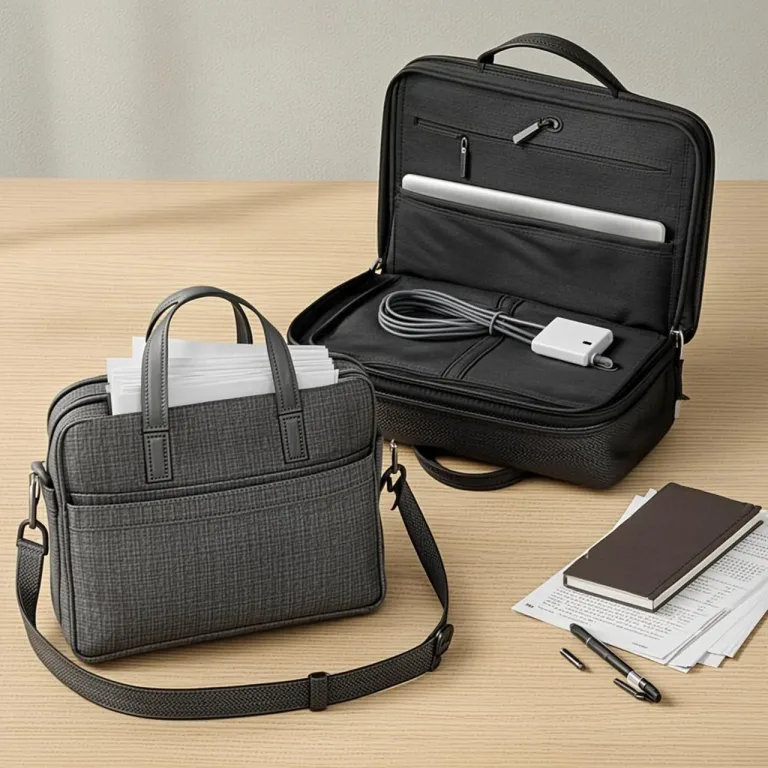
A satchel is generally a structured or semi-structured bag with a relatively flat body, a defined base and handles positioned near the top. Modern satchels can include:
- Two top handles
- A detachable shoulder strap
- A front pocket
- Zipper or flap closure
- Document compartments
- Laptop storage
- Internal organizer pockets
The existing satchel bag guide describes the category as covering a broad range of designs, from smaller everyday bags to larger work-oriented versions that can carry laptops and A4 documents. This makes satchel more of a design category than a precise capacity specification. A small satchel might carry a notebook and personal items. A larger business satchel can be designed around a laptop, documents, charger and accessories. For work applications, the actual internal dimensions are therefore more important than the word “satchel” on a product listing.
3. What Is a Messenger Bag?
A messenger bag is generally a soft-sided or semi-structured bag carried with a long shoulder strap. It commonly has:
- A rectangular body
- Long adjustable shoulder strap
- Flap, zipper or combination closure
- Main document compartment
- Accessory pockets
- Optional padded laptop compartment
Modern business messenger bags are commonly adapted for office commuting, meetings, business travel and mobile work. The current messenger bag guide specifically covers laptop messenger bags, business messenger bags, conference messenger bags and structured Oxford-fabric messenger bags. The main functional advantage is access: the user can move the bag toward the front of the body without completely removing it, which can be useful when retrieving documents, phones, badges or other small items. For a formal definition of the messenger bag style, the Merriam-Webster dictionary offers a useful reference.
4. Which Looks More Professional?
For traditional business environments, a satchel often has an advantage because its top handles and structured body create a more controlled silhouette. A professional satchel can resemble a softer briefcase while remaining easier to carry outside formal meetings. A messenger bag usually communicates a more flexible and mobile style.
That does not mean messenger bags are unprofessional. A well-designed messenger bag with neutral fabric, clean hardware, minimal external decoration, a structured base, a padded laptop compartment and restrained logo placement can work very well in a modern office. The difference is mainly one of visual positioning.
Satchel is often better suited to formal business-casual offices, client meetings, mixed office and personal use, professionals who switch between hand and shoulder carrying, and corporate gifts where presentation matters. Messenger is often better suited to daily commuting, public transportation, walking between locations, trade shows, training events, mobile sales teams and business-casual environments. The choice should reflect the user’s working environment rather than assuming one style is universally more professional.
5. Which Is Better for Carrying a Laptop?
Both can be good laptop bags if they are designed around the actual computer. The critical factors are internal length, internal width, device thickness, padding, bottom protection, opening width, closure and compartment layout.
Do not select a laptop compartment solely from the advertised screen size. Two laptops marketed with the same screen size can have different external dimensions. The site’s existing laptop bag size guide recommends checking the actual device dimensions before finalizing a custom compartment. This is especially important for OEM projects where the bag is designed around a particular company-issued computer.
Satchel laptop bag. A laptop satchel can be useful when the user needs a combination of laptop, A4 documents, notebook, charger and personal items. Its structured body can help maintain separation between flat documents and other contents.
Messenger laptop bag. A laptop messenger bag can be more convenient for users who frequently access the computer or documents during a commute. The crossbody strap also makes it easier to keep both hands available while walking. For either style, test the sample with the actual laptop rather than relying only on the nominal laptop size.
6. Satchel vs Messenger Bag for Commuting
Commuting is one of the areas where the differences become most noticeable.
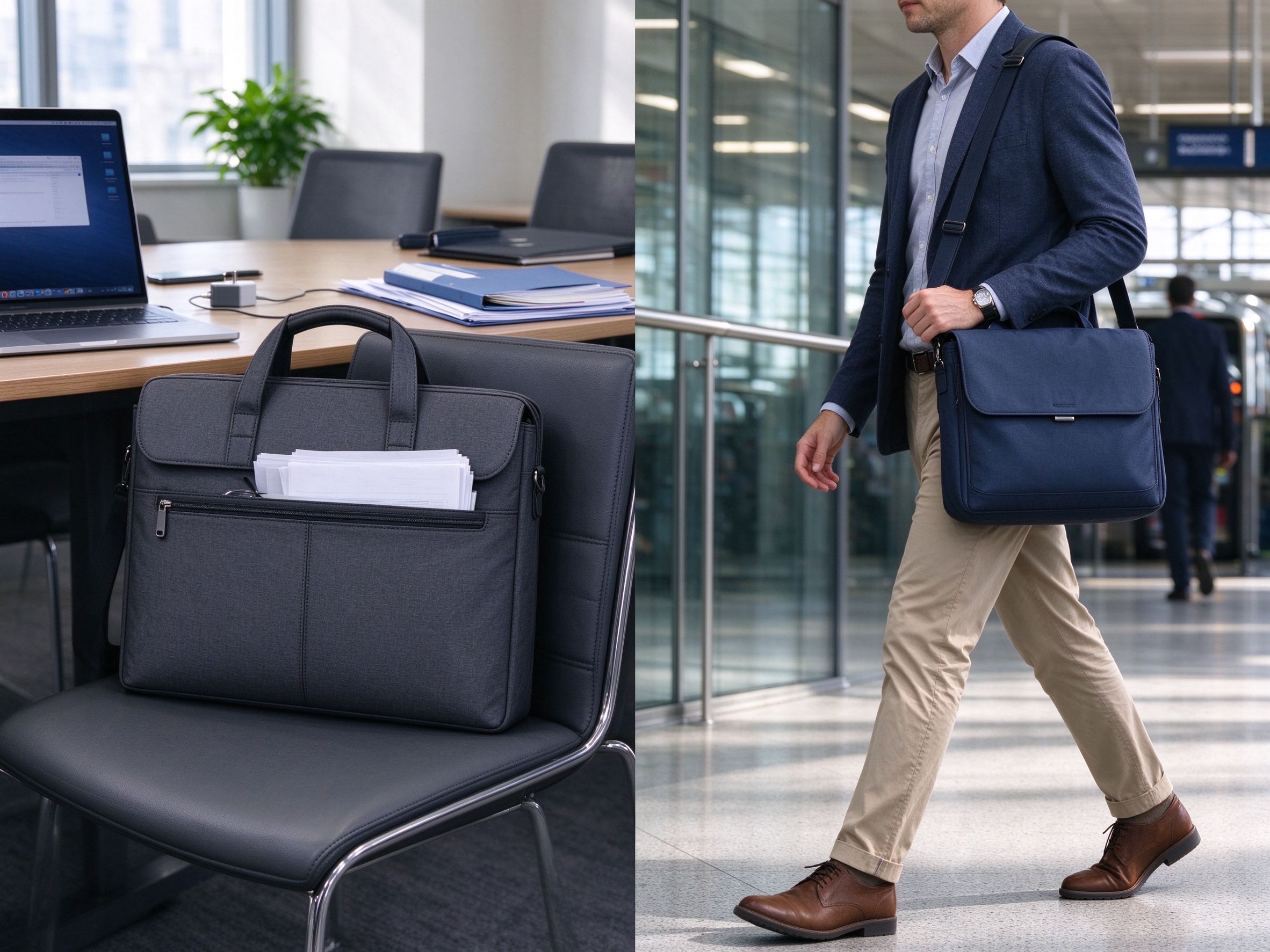
Walking to work. A messenger bag can be convenient because the strap keeps the bag attached to the body while both hands remain free. A satchel can also work well if it has a comfortable detachable shoulder strap. For a longer walking commute, pay particular attention to bag weight, strap width, shoulder padding, strap attachment and load distribution. The existing messenger-bag guide recommends paying particular attention to strap width and padding when the bag carries a laptop and documents.
Public transportation. A messenger bag provides quick access and can be rotated toward the front of the body. A satchel with a shoulder strap can provide similar flexibility, but its more structured body may take up more space depending on its dimensions.
Business travel. A satchel can be particularly useful when the bag needs to transition between airport, office, meeting room and client visit. A messenger bag may be preferable when mobility and quick access are more important than formal presentation.
7. Which Holds Documents Better?
A satchel can be particularly effective for documents because its structure often supports a wide, relatively flat main compartment. It may accommodate A4 folders, presentation materials, notebooks, documents, a laptop, a charger and more. A messenger bag can provide similar capacity, but its softer construction may allow the contents to shift more depending on the design.
For professional document carrying, look for a dedicated document compartment, adequate opening width, a stable base, internal divider panels, protection from other accessories, and enough depth without excessive bulk. For a corporate order, create a simple contents list before selecting the bag. For example: 14-inch laptop + charger + A4 folder + notebook + mouse + phone. That list is much more useful to a manufacturer than simply saying “business satchel.”
8. Which Has Better Capacity?
Neither category automatically has greater capacity. A large messenger bag can hold more than a small satchel, and a large satchel can hold more than a slim messenger. Compare actual dimensions and internal layout.
- A compact satchel may suit a tablet, notebook, documents and small accessories.
- A larger work satchel may suit a laptop, A4 documents, charger, notebook, mouse and headphones.
- A slim messenger may suit a tablet, notebook, charger and documents.
- A larger messenger may suit a laptop, A4 folder, charger, accessories and small work equipment.
The intended contents should determine the dimensions.
9. Which Is Easier to Carry by Hand?
The satchel usually has the advantage because top handles are one of its defining features. This can matter when entering meetings, offices, hotels, conference rooms and client locations. The user can carry the bag by hand for a short distance and then switch to the shoulder strap during a commute. A messenger bag can also have a top handle, but this is not always the primary carrying method. If the intended product needs both formal hand carrying and hands-free commuting, a satchel with a detachable shoulder strap can be a useful hybrid.
10. Which Is Better for Conferences?
Both can work, but the better choice depends on the event. A satchel may be appropriate for executive conferences, training programmes, professional seminars, client-facing events and employee onboarding. A messenger bag can be particularly useful for trade shows, large exhibitions, mobile event staff, attendees carrying materials between sessions, and events where hands-free movement is important.
The same principle that applies to choosing conference bags applies here: select the format according to what attendees actually need to carry. If attendees receive an A4 folder, notebook, tablet and charger, specify those contents before selecting the design.
11. Which Is Better for Corporate Branding?
Both provide useful branding areas, but the available surface can differ. Satchel branding locations can include the front panel, flap, side label, interior label, handle tag, metal logo plate and woven label. A structured front panel can provide a clean area for restrained corporate branding. Messenger bag branding locations can include the front flap, front pocket, main panel, side label, woven label, rubber patch and zipper pull. A messenger bag can provide a highly visible front-facing branding area.
The best logo location depends on fabric, bag construction, logo dimensions, decoration method and intended audience. For companies developing branded work bags, the custom bags with logo page is a useful next step because it covers logo artwork, branding options, corporate programs and private-label customization.
12. Which Is Better for OEM Customization?
Both formats are suitable for OEM development. The main difference is where customization affects the product. Satchel customization can cover overall dimensions, handle length, handle reinforcement, shoulder strap, laptop compartment, document divider, front pocket, base structure, fabric, lining, hardware, logo and packaging. Messenger customization can cover bag dimensions, strap width, strap padding, strap length, laptop compartment, document storage, front pocket, closure, base reinforcement, fabric, lining, hardware, logo and packaging.
For a laptop-focused project, the internal compartment should be developed around the real device dimensions. The custom laptop bag manufacturer page describes OEM and ODM laptop-bag production and specifically notes the importance of confirming requirements for bulk orders.
13. Satchel or Messenger Bag: Which Is Better for Different Users?
- Office professionals. Satchel: strong choice for users who want a polished appearance and switch between hand and shoulder carrying. Messenger: better for users who prioritize mobility and quick access.
- Sales teams. Satchel: useful for client meetings and document-heavy work. Messenger: useful for frequent travel between offices and appointments.
- Consultants. Both can work. A satchel may be preferable when presentation is important. A messenger may be more practical for frequent commuting.
- Conference attendees. A satchel can suit structured professional events. A messenger can be useful when attendees spend more time walking around the venue.
- Training participants. Either format can work, depending on whether the program provides laptops, documents or other equipment.
- Corporate gifts. A satchel can create a more formal gift impression. A messenger may communicate a more contemporary, practical image.
14. When Should You Choose a Satchel?
Choose a satchel when the main priorities are professional appearance, hand-carrying, flexible shoulder carrying, document organization, moderate laptop capacity, business-casual use, client-facing situations and corporate gifting. A satchel is especially useful when the recipient needs one bag that can transition from the office to meetings and commuting.
15. When Should You Choose a Messenger Bag?
Choose a messenger bag when the main priorities are hands-free carrying, fast access, public transportation, walking, mobile work, crossbody stability, trade shows and flexible everyday use. A messenger bag is particularly useful when the recipient frequently moves between locations and needs to access the contents without putting the bag down.
16. How Should Businesses Specify a Satchel or Messenger Bag?
For a wholesale or OEM order, start with the use case rather than the product name. A useful product brief should include:
- Intended user. For example: employees, sales representatives, conference attendees, students, clients or distributors.
- Contents. List everything that needs to fit: laptop, tablet, documents, notebook, charger, mouse, headphones and personal items.
- Device dimensions. Provide the actual laptop or tablet measurements.
- External dimensions. Specify target width, height and depth.
- Internal organization. Define laptop sleeve, document divider, front pocket, accessory organizer, pen loop and zipper pocket.
- Carrying system. Specify whether the bag needs top handles, a detachable shoulder strap, an adjustable strap, a padded shoulder section or reinforced attachment points.
- Branding. Provide logo file, logo size, preferred location, brand colors and preferred decoration method.
- Packaging. Specify individual bags, labels, polybags, cartons and private-label packaging.
- Quantity and timing. Provide quantity, colour breakdown, destination and required in-hand date.
The more complete the specification, the easier it is to compare supplier quotations on an equivalent basis.
17. Sample Approval Matters More Than the Product Name
A product photograph cannot show every important detail. Before bulk production, a representative sample should be checked for actual dimensions, laptop fit, document fit, strap length, handle comfort, pocket accessibility, logo position, logo appearance, stitching, hardware and overall balance. This is particularly important for custom orders because changing the compartment or strap after mass production begins can be much more difficult than correcting it during the sample stage. The sample-approval stage is part of the normal custom manufacturing process, so build it into the project timeline rather than treating it as an extra step.
18. Satchel Bag vs Messenger Bag: Quick Decision Guide
Choose a satchel if: you want a more structured appearance; hand carrying is important; the user attends formal or client-facing meetings; documents need to remain organized; a detachable shoulder strap is useful; or the product is intended as a corporate gift.
Choose a messenger bag if: hands-free carrying is important; the user walks or uses public transportation; fast access is a priority; the bag will be used at trade shows; the recipient frequently moves between locations; or a crossbody carrying position is desirable.
Consider a hybrid design if: the bag needs both handles and a shoulder strap; the user alternates between office meetings and commuting; a laptop and documents must be carried together; or the product needs to look professional without being overly formal.
19. Satchel Bag vs Messenger Bag: FAQ
Are satchel bags more professional than messenger bags?
A structured satchel usually reads as more formal because of its top handles and defined silhouette. A well-built messenger bag with neutral fabric and restrained branding can also look professional in a modern office. The right choice depends on the working environment rather than a fixed rule.
Can a satchel be carried crossbody?
Yes. Many modern satchels include a detachable shoulder strap that can be worn over one shoulder or across the body. This makes the satchel a useful hybrid when the user wants both hand carrying and hands-free commuting.
Which is better for commuting, a satchel or messenger bag?
For long walking commutes and public transportation, a messenger bag is usually more convenient because of its hands-free crossbody carry and quick access. A satchel with a padded shoulder strap can also work well when the user also needs a formal appearance at the destination.
20. Final Verdict
A satchel bag vs messenger bag decision is ultimately a design decision. A satchel is generally the better choice when structure, professional appearance, document organization and flexible hand-or-shoulder carrying are the priorities. A messenger bag is generally the better choice when mobility, hands-free carrying, quick access and commuting convenience matter more. Neither category is automatically superior.
For personal use, the decision should be based on the user’s actual daily load and working environment. For corporate and wholesale purchasing, define the recipient, contents, laptop dimensions, internal organization, carrying method, branding requirements and delivery schedule before choosing the final format. If the bag will spend most of its life in meetings and offices, a structured satchel may be the stronger direction. If the recipient spends much of the day walking between locations or using public transportation, a messenger bag may provide greater practical flexibility. For a B2B project, the most useful approach is to treat the satchel bag vs messenger bag choice as a product-design decision rather than simply a style decision.