Business Bags for Sales Representatives: How to Choose the Right Work Bag
Why Sales Representatives Need a Different Type of Business Bag
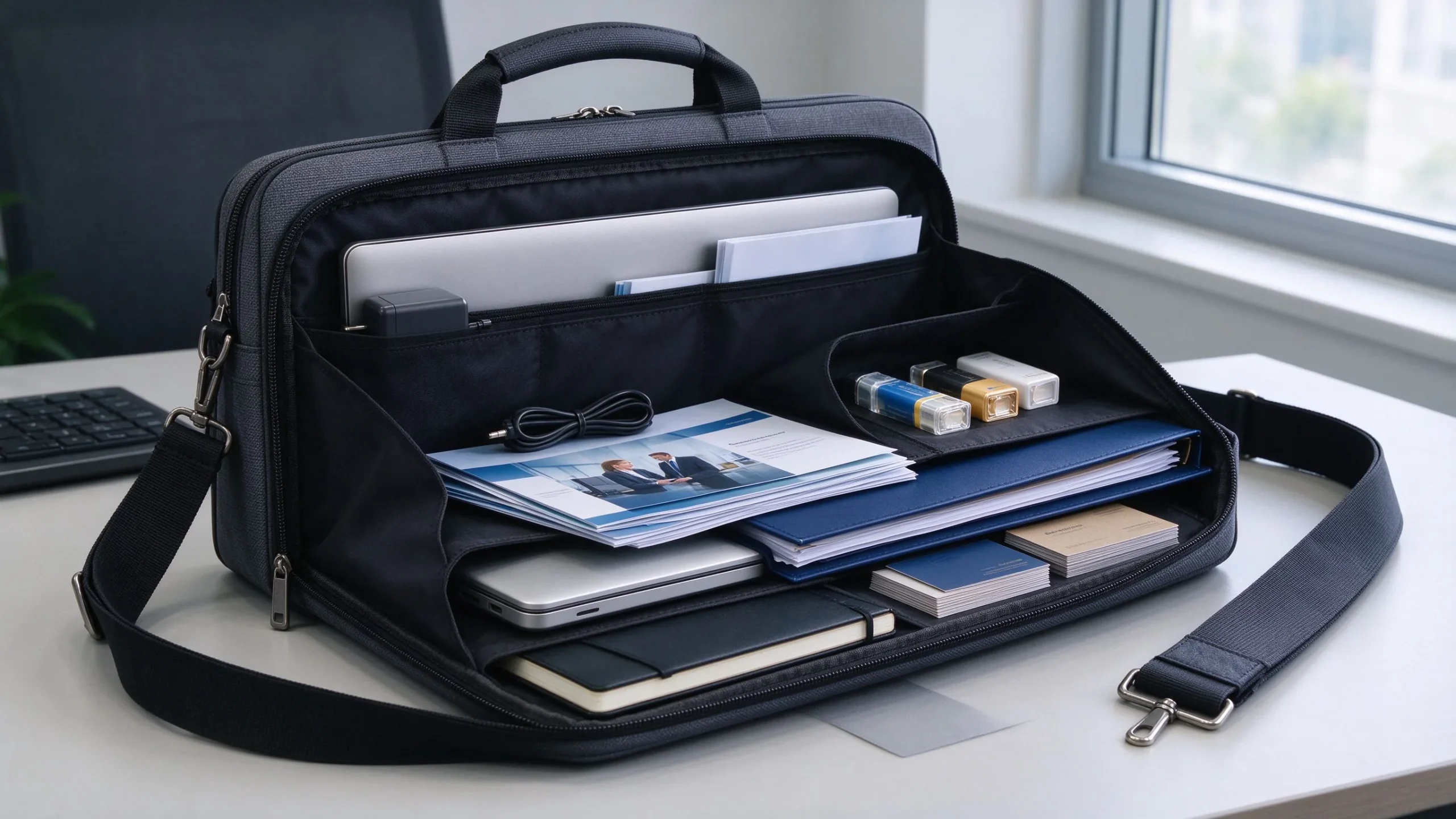
Picking the right business bags for sales representatives starts with one fact: reps carry more than a laptop, and that changes everything about the bag. A single customer visit often means a laptop or tablet, charger, A4 brochures, price lists, a couple of contracts, business cards, and a few physical samples—all moved between a car, a lobby, and a conference table. A commute bag built for an office worker who walks ten minutes from the train simply won’t survive that kind of day.
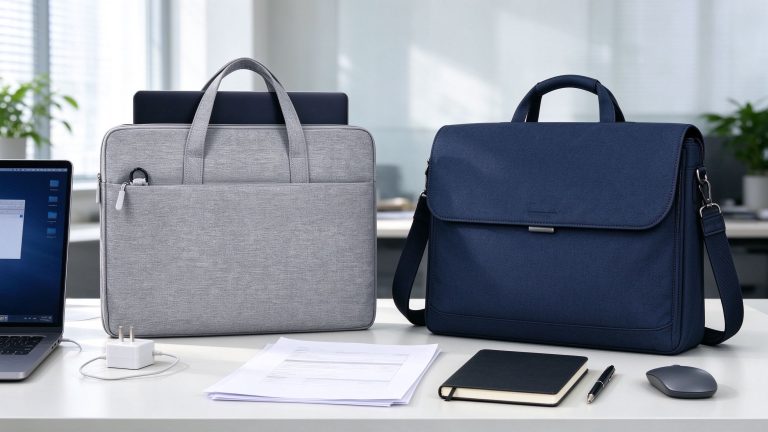
A laptop sleeve protects the computer but leaves nowhere for the catalogues. A large rolling case holds everything but is overkill when you’re popping into three offices in an afternoon and need to stand at a reception desk. The right sales bag is chosen around the actual routine—how many meetings, how much walking, how heavy the samples—not around the laptop alone.
The requirements shift by role too. A pharma rep schlepping sample cases between clinics has a different layout than a SaaS account manager who carries a laptop and a notebook into boardrooms. Start with the job, then pick the format.
Start With the Sales Kit
Before anyone speculates about leather versus nylon, write down what the rep actually puts in the bag on a Tuesday. The list usually looks something like this:
- Laptop or tablet, plus charger and mouse
- A4 brochures, product catalogues, and price sheets
- Contracts, quotation sheets, and a notebook
- Business cards, pens, phone, keys
- Product samples, swatches, or demo accessories
- Wallet, passport, and the usual personal items
Design the bag around the bulkiest, most awkward items first. If samples are the awkward part, you need depth and a reinforced base—not a slimmer profile. If it’s mainly a laptop and a couple of documents, a slim laptop briefcase will do. Writing the contents out as a list is how you avoid ordering a bag that looks right but never quite fits the real day.
Best Bag Formats for Sales Representatives
Laptop briefcase
The default for most office-based sales teams. A padded laptop compartment, a divider for documents, a charger pocket, and a front organiser for cards and pens. Top handles for the meeting room, a detachable shoulder strap for the walk through the car park. If the sales kit is laptop plus a few brochures, this is the format that gets ordered most often.
Structured business briefcase
Wider and deeper than a laptop briefcase, built for reps who carry product folders, multiple notebooks, contracts, and samples alongside the computer. The structure reads more formally at a client table. The trade-off is weight—an empty structured briefcase is already heavier, and a loaded one gets heavy fast, so it’s worth keeping the contents list honest.
Messenger or crossbody work bag
The right call for reps who move between customer sites on foot, on public transport, or across a large industrial park. Hands-free, quick to swing around at a counter, easier in less formal environments. Check the strap: on a bag carrying a laptop and samples, a thin nylon strap will dig in within an hour. Look for a wide, adjustable, padded shoulder strap.
Conference or meeting bag
Built for trade shows, dealer meetings, product launches, and training days. Prioritises light weight, a big opening for brochures, and a clean front panel for the logo. These are closer to event bags than daily carry—if the team uses the same bag for both client visits and exhibitions, the conference-bag format tends to win on capacity but lose a little on formality.
Sample or presentation case
When the job is physical samples, swatches, or demo hardware, the bag stops being a laptop bag and becomes a case. You need a wide opening, a reinforced base, extra depth, removable dividers, an easy-clean lining, and stronger handles. Pick this format from the actual samples on the shelf, not from a generic bag category.
How Much Capacity Does a Sales Bag Need?
There’s no one-size sales bag. Capacity follows the kit, and most sales teams fall into one of three tiers.
Light kit—tablet, notebook, contracts, cards, charger. A slim laptop bag, a portfolio-style case, or a compact briefcase handles this without the bulk.
Standard kit—laptop, charger, A4 documents, brochures, a notebook, small accessories. A medium laptop briefcase or structured shoulder bag is the sweet spot; big enough for the day, small enough to sit on the floor beside a client’s chair.
Heavy kit—laptop plus large charger, product samples, catalogues, folders, pricing sheets, demo items. Move up to a larger business briefcase, a sample bag, or a custom sales case. Resist the urge to keep going bigger—an oversized bag just invites overpacking and a sore shoulder by 4 p.m.
Organizing the Interior for Fast Customer Meetings
Sales reps open their bag standing in front of a reception desk or sitting across from a buyer. The interior needs to support that: grab the contract, hand over the business card, pull out the sample—without upending the whole bag.
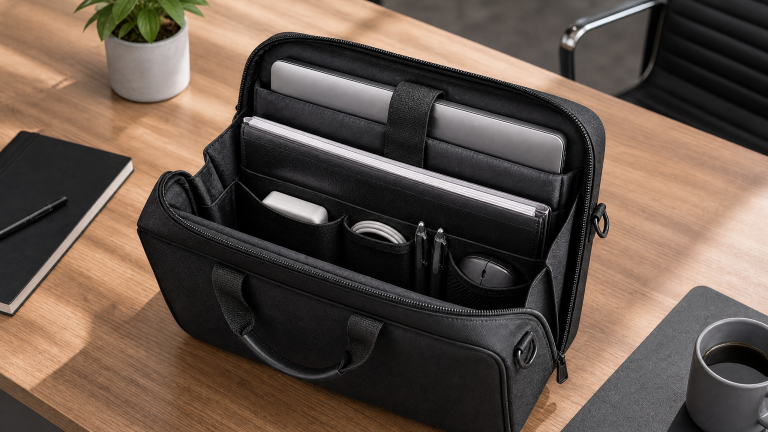
A few compartments earn their keep. A padded laptop compartment keeps the computer away from brochures and sample corners that scratch it. A document divider separates new proposals from signed contracts and customer files, so you’re not rifling through a stack. A front organiser pocket holds cards, pens, phone, keys, and charging cables. A larger open section takes catalogues, brochure reams, and sample books. A zipped valuables pocket keeps a wallet, passport, or small electronics out of sight. And removable dividers let different reps reconfigure the space for what they personally carry.
More pockets isn’t the goal. A sample should be packed with the real kit before approval—pockets that don’t match real items just become places where cables and receipts disappear.
Laptop and Device Protection
Size the compartment to the actual laptop, not to the marketing label. “Fits a 15.6-inch laptop” is a starting point, not a guarantee—two models with the same screen size can differ by a centimetre in width or thickness, and a protective case adds more. Measure the laptop length, width, and closed thickness, plus the charger dimensions and any tablet.
If the team runs several laptop models, build in flexibility: an adjustable padded compartment, multiple internal sizes, a separate sleeve inside, or simply different bag versions per department. For a device-specific program, a custom laptop bag manufacturer can work from the exact device dimensions and accessory layout before sampling—worth doing before 500 bags get cut to the wrong size.
Materials for Sales Bags
Oxford fabric
Oxford cloth is the workhorse for sales-team bags. It’s light, takes silk-screen and heat-transfer logos cleanly, holds structured business colours, and scales into bulk production without the cost of leather. The finish depends on the coating, padding, and sewing construction, so check a physical sample—not just a swatch photo—before ordering.
Nylon and polyester
Good for lighter, more flexible, travel-oriented bags where weight matters more than a rigid silhouette. Fine for messenger and conference formats; less formal at the client table.
PU leather
Delivers a smoother, more executive look for client-facing programs at a fraction of genuine leather. Worth considering for account managers and leadership-facing roles where the bag is part of the presentation.
Genuine leather
Prices up the bag, adds weight, and demands more care. It has its place for premium positioning, but for a field sales team that walks between sites every day, the weight and maintenance usually aren’t worth it.
Carrying Comfort for Mobile Sales Teams
A bag that feels fine empty will feel very different once the laptop, charger, and samples go in. Test it loaded, not empty. The handle drop matters for swinging the bag onto a desk; the shoulder strap width and padding matter for a 20-minute walk between appointments. A crossbody strap distributes weight better than a single-shoulder carry, while top handles read more formally in a meeting room.
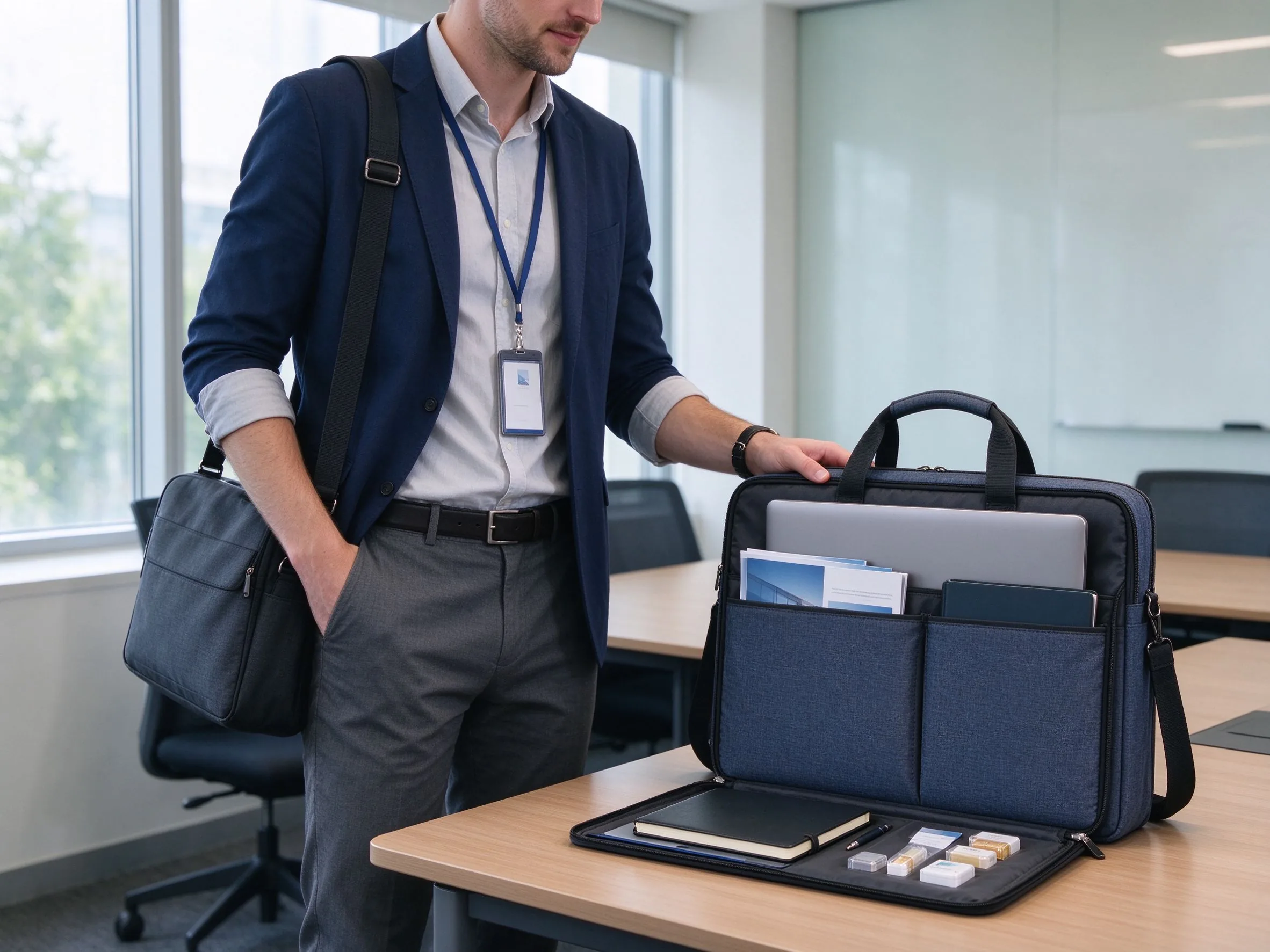
Build the carrying test into the sample approval: load the bag with the real kit, walk around, and open it standing up. If the strap digs in or the bag swings awkwardly when full, that’s a problem no logo will fix.
Branding a Sales Representative’s Bag
A sales-team bag should carry the brand without turning into a walking billboard. Common placement options are the front panel, front pocket, a handle tab, a shoulder-strap label, an interior label, or a zipper pull. Decoration methods include silk-screen printing, heat-transfer printing, woven labels, embroidery, rubber patches, metal badges, and embossing on surfaces that take it.
The right method depends on logo size, number of colours, fabric texture, quantity, and whether the bag is for internal reps or handed out at customer events. As a rule, keep the logo restrained on a bag reps carry daily—a small clean mark reads more professional than a large full-colour print. When deciding placement and decoration, review the custom bags with logo options available for the program.
Choosing Colours for a Sales Team
Black, navy, charcoal, and dark grey are the practical defaults. They hide scuffs, work across men’s and women’s wardrobes, and give the logo good contrast. Brighter corporate colours earn their place at events and launch campaigns, but they age faster and clash with more clothing on a daily client visit.
If a company runs multiple colours, specify the quantity per colour, the logo treatment per colour, and how packaging or department allocation differs—otherwise the factory ends up guessing.
Sales Bags for Trade Shows and Events
The same bag often doubles as the daily carry and the trade-show bag, but events demand more: easy access for brochure handouts, more visible branding for booth traffic, and room for lead forms and promotional giveaways on top of the usual kit. For a conference- or event-focused bag, working with a conference bag manufacturer aligns the format, logo placement, and packaging with what actually goes into the bag on show day.
What Companies Should Specify Before Ordering
A corporate order goes sideways when the buyer picks a bag from a catalogue and hopes it fits. Write it down first.
Who uses it: field reps, account managers, distributor teams, technical sales, sales managers, or event staff—each group carries something different.
What goes in it: laptop, tablet, documents, brochures, samples, chargers, accessories. List dimensions, not just names.
Bag format: laptop briefcase, business briefcase, messenger, crossbody, conference bag, or sample case.
Dimensions: external size, internal laptop compartment, main compartment depth, pocket sizes.
Material and lining: Oxford, nylon, polyester, PU, or leather, plus padding and lining.
Branding: logo file, decoration method, position, size, labels, packaging.
Order details: quantity, colour breakdown, sample requirement, delivery schedule, shipping destination, and the plan for repeat orders.
The existing wholesale briefcase procurement flow—product selection, artwork, sampling, bulk production, quality review, delivery—is the right backbone for a structured sales-bag program, especially when the company expects to reorder the same bag for new hires.
Common Mistakes When Choosing Sales Bags
Buying a laptop sleeve for a sample-heavy role. The laptop fits; the brochures and samples don’t.
Choosing on looks alone. A polished exterior doesn’t help if the interior is impossible to organise or the strap cuts into a shoulder by noon.
Oversizing. A bigger bag invites more stuff, and more stuff means a heavier bag.
Forgetting the charger. Chargers and power bricks need their own pocket—shoving them in a corner scratches the laptop.
Adding too many small pockets. Pockets are only useful if they match real items; otherwise they’re cable and receipt graveyards.
Thin strap on a heavy bag. Padding and width matter once the bag is loaded.
Not testing it in a meeting setting. The bag should open, yield the contract, and close without shedding samples on the client’s floor.
Approving the logo before checking the material. A logo that looks crisp on a smooth PU panel can disappear or bleed on textured Oxford cloth. Always approve the logo on the actual fabric.
A Practical Sales-Bag Checklist
Before sign-off, run through:
- Sales role and daily use case
- Laptop or tablet dimensions, including thickness and case
- Charger and accessory sizes
- Document and brochure sizes (A4 vs. letter)
- Product sample dimensions and weight
- Preferred bag format
- Internal compartment layout—trial-packed with real items
- Material, lining, and padding
- Handle drop and shoulder strap (loaded test)
- Logo method, size, and placement on the real material
- Colour breakdown per department or region
- Packaging requirements
- Quantity and repeat-order plan
- Sample approval and quality checkpoints
- Delivery schedule and shipping destination
Final Thoughts
The best business bag for a sales rep isn’t the fanciest one on the catalogue—it’s the one that matches the actual Tuesday. A laptop briefcase handles a light professional kit. A structured business briefcase earns its place when folders, brochures, and samples are part of the job. A crossbody messenger suits teams moving on foot, and a conference bag is the right call for shows, training, and launches.
Do the boring part first: list what goes in the bag, measure the laptop and the bulkiest sample, then size the compartments, material, and carrying system around that list. For companies ordering custom or wholesale, lock in branding, quantity, sampling, and repeat-order terms up front. A bag that fits the routine shows up every day—and quietly presents the company more professionally than any pamphlet ever will.